Earlier this month, dermatologist Dr. Ajay Rana was in the news for a new laser-based technique that tightens skin without surgery — no incisions, no scalpel, no weeks of downtime. Around the same time, New Delhi hosted COSCON 2026, the 4th International Congress of the Indian Society of Aesthetic Medicine (ISAM), where doctors and innovators from around the world gathered under the theme “Aesthetics Beyond Borders.”
Two stories, one signal: aesthetic medicine is moving fast, and India is no longer just watching from the sidelines — it’s setting the pace. For anyone weighing a career in this field, that’s not just interesting news. It’s a roadmap. And it’s exactly why interest in aesthetic medicine training India-wide has climbed so sharply over the last few years — practitioners can see where the field is headed, and they want to be trained for it before the gap widens further.
This piece unpacks what’s actually happening in the industry right now, why it matters for your career, and what serious aesthetic medicine training in India looks like when it’s built to international standards.
The Non-Surgical Revolution Is Reshaping the Entire Specialty
For decades, meaningful skin tightening, contouring, or rejuvenation meant surgery — general anaesthesia, incisions, and weeks of recovery. That’s no longer the default. Devices and protocols like the one Dr. Rana recently demonstrated are part of a much broader shift toward non-surgical, minimally invasive aesthetic procedures: treatments patients want because they’re faster, safer, more affordable, and require little to no downtime.
This isn’t a fringe trend confined to a few metro clinics. Industry analysts have pointed out that non-surgical cosmetic procedures overtook surgical ones globally as far back as 2020, a shift tracked by the International Society of Aesthetic Plastic Surgery (ISAPS) and echoed consistently in more recent market reporting. Energy-based devices — lasers, radiofrequency, ultrasound — sit right at the centre of that shift, alongside injectables like Botox and dermal fillers.
For practitioners, this changes what “being good at aesthetic medicine” actually means. It’s less about surgical dexterity alone and more about mastering an expanding toolkit of devices, each with its own settings, safety margins, and skin-type considerations. That’s a very different skill set — and it’s exactly what good aesthetic medicine training in India now has to be built around, since it’s one that has to be taught hands-on, not read about in a textbook.
India’s Aesthetic Medicine Market, By the Numbers
The scale of this shift becomes clearer when you look at where the money — and the patients — are actually going, and it’s a big part of why demand for quality aesthetic medicine training in India has grown alongside it.
Industry coverage of India’s aesthetic medicine sector has pegged the market at somewhere in the range of $1.6 billion currently, with projections of it nearly tripling within the next several years, driven overwhelmingly by rising demand for non-invasive procedures, growing disposable incomes, and a health-conscious, increasingly appearance-aware population. Zoom in specifically on aesthetic devices — the lasers, energy-based systems, and body-contouring equipment that make non-surgical treatment possible — and the picture is just as striking: energy-based systems already account for more than 60% of India’s aesthetic devices market, and that segment is projected to keep growing at a double-digit pace over the next several years.
Put simply: the fastest-growing part of a fast-growing industry is the part that requires the most specialised, hands-on training — laser and energy-based device work. That’s a direct opportunity for anyone pursuing structured aesthetic medicine training in India rather than picking up fragmented, device-specific workshops here and there.
It also explains why dermatology clinics and aesthetic centres — not hospitals — have become the primary setting where this growth is happening. Smaller, specialised, and built entirely around the patient experience, these clinics need practitioners who can walk in already competent on modern equipment, not ones who need months of on-the-job supervision before they’re client-ready. Increasingly, that’s why hiring managers at these clinics specifically ask candidates whether they’ve completed formal aesthetic medicine training in India, rather than a scattering of unrelated device workshops.
The World Convened in Delhi: What COSCON 2026 Signals
COSCON 2026 wasn’t just another item on the conference calendar. As ISAM’s flagship international congress, held under the guidance of the International Union of Aesthetic Medicine (UIME), it brought practitioners, researchers, and innovators from across the globe to New Delhi for two days of scientific sessions, hands-on workshops, and panel discussions on where aesthetic medicine is headed next.
That matters for a simple reason: it’s a strong signal that India has become a genuine hub for aesthetic medicine education and innovation — not merely a market that absorbs technology developed elsewhere, but a country whose practitioners are shaping global conversations, publishing research, and hosting the doctors who define international best practice.
Dr. Ajay Rana, ILAMED’s Founder & Director, has been central to that shift for years. As President of ISAM and UIME’s Secretary for Asia, he has spent much of the last two decades connecting Indian practitioners to international faculty, research, and standards — the same philosophy ILAMED was built on back in 2003: don’t just teach aesthetic medicine, teach it to a global benchmark, so Indian-trained practitioners can hold their own anywhere in the world.
What This Growth Means If You’re Building a Career in Aesthetic Medicine
Every time the field advances — a new device, a new injectable technique, a new non-surgical protocol — the gap widens between practitioners who are properly trained on it and those who aren’t. That gap is precisely what structured aesthetic medicine training in India is designed to close, and it applies across a wider range of professional backgrounds than most people assume:
- Dermatologists and cosmetic surgeons looking to expand beyond core dermatology into advanced laser and injectable procedures, where patient demand is growing fastest.
- General physicians transitioning into aesthetic practice, drawn by shorter procedure times, high patient satisfaction, and strong clinic economics compared to general practice.
- Cosmetologists and skin therapists who want to move from cosmetic-grade treatments into medically supervised, results-driven aesthetic procedures.
- Dentists expanding into facial aesthetics — a natural extension of existing anatomical expertise, and one of the fastest-growing crossover specialities globally.
- Nurses and physician assistants seeking specialised certification to administer injectables and operate energy-based devices under medical supervision.
In every one of these paths, the constraint isn’t demand — clinics across India are actively hiring and expanding. The constraint is trained, certified supply. Untrained or under-trained practitioners create safety risks and inconsistent results, which is precisely why patients — and increasingly, employers — are getting more discerning about where a practitioner actually trained.
Why Training Quality Matters More Than Ever
Not all aesthetic medicine training in India is built the same way, and the gap between a weekend certificate and genuine clinical competence has never mattered more.
A few things worth checking before committing to any program:
- Is it hands-on, with real patients? Device settings, injection depth, and technique nuances simply don’t transfer from slides and videos. Supervised, live-patient practice is non-negotiable.
- Is it internationally benchmarked? Programs aligned with recognised global bodies (like UIME) or affiliated with established medical institutions carry weight with employers, patients, and regulators alike — well beyond India’s borders.
- Who’s actually teaching it? Faculty who are themselves active clinicians — publishing research, speaking at international congresses, treating real patients — bring current, evolving knowledge, not a syllabus frozen five years ago.
- Does it cover safety and complication management, not just technique? Anyone can be taught to operate a laser. Fewer programs teach you to recognise and manage what happens when something doesn’t go to plan.
Inside ILAMED’s Approach to Aesthetic Medicine Training in India
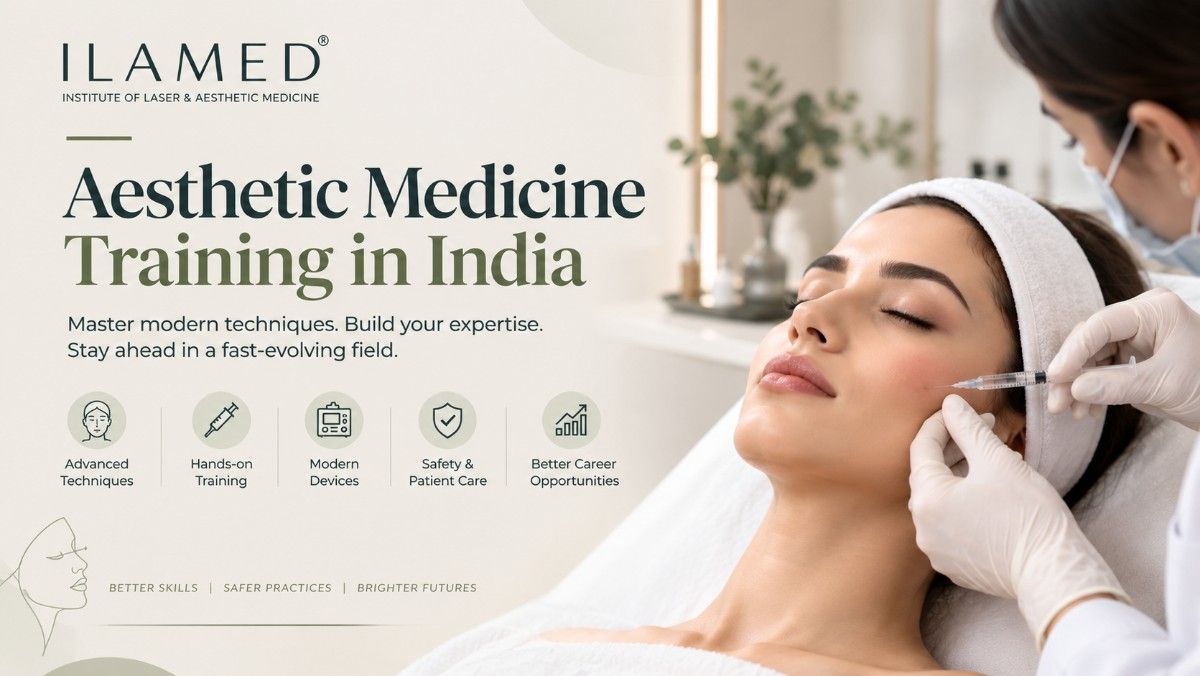
This is exactly the gap ILAMED was created to close. Since 2003, ILAMED — the Institute of Laser & Aesthetic Medicine — has positioned itself as one of the few institutions offering genuinely comprehensive aesthetic medicine training in India, structured and hands-on across the full breadth of the specialty, not just isolated device workshops.
What that looks like in practice:
- Hands-on clinical training with real patient exposure, rather than simulation-only or theory-heavy coursework.
- Internationally accredited programs, aligned with UIME standards and affiliated with globally recognised institutions, including the University of Greifswald in Germany, New York Medical College, and the University of Camerino in Italy.
- A curriculum spanning aesthetic medicine and surgery, cosmetology, cosmetic gynaecology, aesthetic dentistry, trichology, and regenerative medicine — built for practitioners who want to specialise deeply, not skim the surface.
- Faculty who are themselves active in the field, led by Dr. Ajay Rana alongside a global network of physicians who train, publish, and present at international congresses like COSCON.
- A 20+ year track record, having trained hundreds of doctors, dermatologists, and cosmetologists across India and internationally, many of whom now run their own successful aesthetic practices.
In other words: the same expertise shaping conversations at COSCON 2026 is the expertise you’d be training under at ILAMED. This isn’t training that trails the industry — it’s training built by people actively setting its direction.
How to Get Started
If any of this resonates — whether you’re a licensed physician, dermatologist, dentist, nurse, or cosmetologist — starting aesthetic medicine training in India doesn’t need to be complicated. The next step is simple:
- Identify your specialisation. ILAMED’s programs span aesthetic medicine, laser therapy, injectables, cosmetic gynaecology, aesthetic dentistry, and more — pick the track that matches your existing qualification and career goals.
- Check eligibility and batch timelines. Programs run in structured batches with real-patient clinical exposure, and seats are limited by design to preserve hands-on quality.
- Reach out for a program consultation. ILAMED’s team can walk you through which certification best fits your background and where it can take your practice.
Who should consider aesthetic medicine training in India?
Anyone with a clinical or para-clinical background looking to move into a fast-growing specialty: dermatologists and cosmetic surgeons expanding their scope, general physicians transitioning into aesthetic practice, dentists moving into facial aesthetics, and nurses or cosmetologists pursuing certified, medically supervised skills. Most structured aesthetic medicine training in India is organised into tracks by existing qualification, so you’re not learning alongside people at a completely different starting point.
Do I need a medical degree to enrol in aesthetic medicine training in India?
It depends on the track. Physician-only programs (advanced injectables, certain energy-based devices) require a medical degree, while cosmetology-track programs are built for non-physicians who want to work under medical supervision. A reputable institute will be upfront about which of its aesthetic medicine training in India programs are open to which qualifications, rather than enrolling everyone into the same generic course.
How long does aesthetic medicine training in India typically take?
This varies widely — from short, focused device certifications that run a few weeks, to comprehensive programs spanning several months that combine classroom learning, live-patient clinics, and supervised practice across multiple procedure types. In general, the more hands-on patient exposure a program includes, the longer — and more valuable — it tends to be.
Is aesthetic medicine training in India recognised outside the country?
It can be, but only when the program is deliberately built that way. Training affiliated with international bodies like UIME, or with recognised universities abroad, carries weight with employers and regulators well beyond India’s borders. This is worth confirming directly with any institute before enrolling, since not every certificate travels equally.
Why is this a particularly good moment to start aesthetic medicine training in India?
Three things are converging at once: a market growing at a double-digit pace, a clear industry-wide shift toward non-surgical and laser-based procedures, and rising international visibility for Indian aesthetic medicine — visible most recently at COSCON 2026 in New Delhi. Together, they mean demand for properly trained practitioners is outpacing supply right now, which is exactly when it’s most valuable to get trained.
The Takeaway
Aesthetic medicine isn’t a field you learn once and practice forever — it’s one that rewards practitioners who keep training as the science moves, and right now, it’s moving quickly. Between a booming market, a fast-growing appetite for non-surgical treatment, and India’s rising international profile — underlined by events like COSCON 2026 — this is a genuinely good moment to invest in real aesthetic medicine training in India and ask: is your training keeping pace with where the field is actually going?
Ready to pursue aesthetic medicine training in India that’s built on the same standards shaping global aesthetic medicine? Explore ILAMED’s courses or reach out to our team to find the right program for you — seats for upcoming batches are limited.