
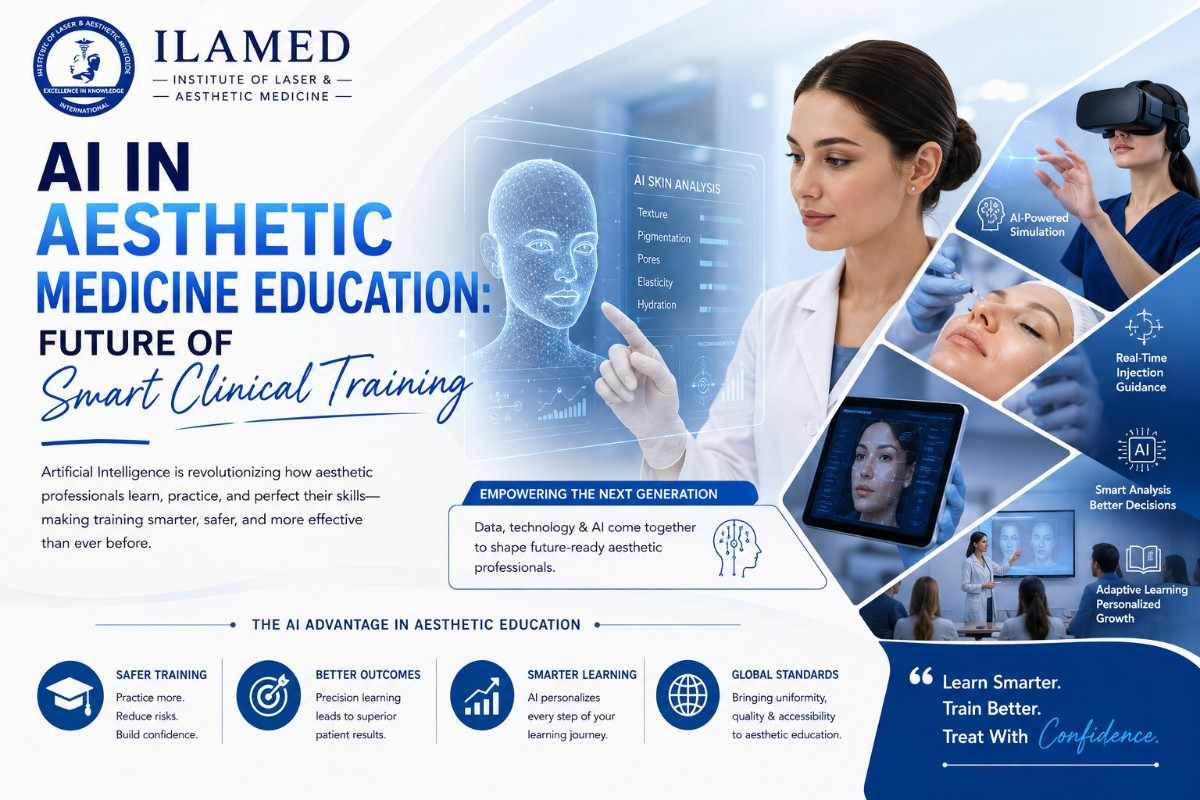
Since the very beginnings of aesthetic medicine, there has been a fine line between art and science. Traditionally, clinical mastery has been achieved only through a steady hand, a trained eye and years of supervised practice. However, a new entity is changing up the way the next generation of injector, aestheticians, dermatologists, and aesthetic physicians are learning their trade: artificial intelligence.
From AI-powered injection simulators allowing students to practice on virtual patients to machine learning technologies that can assess the texture of a patient’s skin within seconds, to adaptive learning platforms that tailor each student’s curriculum, smart clinical training is no longer a concept of the future. It’s already transforming classrooms, laboratories, and clinics throughout the aesthetic medicine community, even in places where there’s a growing demand for well-trained providers, such as training bases like Dubai and Delhi.
This blog delves into the actual tools, technologies, and the benefits and challenges of integrating AI in aesthetic medicine education, as well as what the future of smart clinical training will look like over the coming years.
The Traditional Bottlenecks in Aesthetic Medicine Training
It is useful to understand the challenges AI is addressing before exploring how AI is transforming the industry.It’s important to have a sense of the problems that AI is solving before examining how AI is transforming industry. Traditional aesthetic medicine curriculum has always had to overcome some of the following difficulties:
- Insufficient opportunities for hands-on practice. Not all patients may be available for all trainees to practice on, and early career practitioners may only get a few supervised injections before beginning working independently.
- Inconsistent skill assessment. Traditionally, the depth, angle and symmetry of the injection have been assessed subjectively by the instructor, which results in inconsistent scoring.
- One-size-fits-all curricula. Most of the training programs have a fixed time frame and content, regardless of whether the student is an accelerated learner, and requires more advanced training, or a slow processor of the material and requires more repetition on basic techniques.
- Risks during early learning curve are high. Injections into the nervous system or filler injections into the dermis are risky treatments, particularly for practitioners still developing their muscle memory and anatomical judgment.
- Geographic and access barriers. While some aspiring practitioners can enjoy world-class faculty and facilities, others don’t have that option, especially in emerging markets, where demand for aesthetic procedures is outstripping the number of quality trainers.
It is in these slowdowns that AI-powered tools are starting to make a significant impact.
The Impact of AI in Aesthetic Medicine Clinical Training.The role of AI in aesthetic medicine redefining clinical training.
1. Use AI to create simulations and virtual patients.Create simulations and virtual patients using AI.
One of the most apparent changes is in relation to simulation learning. Trainees can now simulate all kinds of procedures—such as those that require injecting—that they practice on virtual models, and these models can be powered by AI under the hood.
Today, with virtual reality (VR) and augmented reality (AR) platforms, powered in many cases by AI under the hood, these virtual models enable trainees to practice all kinds of procedures that require them to inject before they ever set foot on a real patient. For the more hands-on procedures, like filler and neurotoxin injections, students can use virtual models with systems like Touch Surgery VR and FAIT (Fundamentals of Aesthetic Injectable Training) to practice the procedures with virtual models that react in real time to technique, a process that helps develop muscle memory and confidence in a totally risk-free environment.
A few simulation labs with VR-based filler training have been able to report statistically significant improvements in injector precision, and AI overlays that monitor depth and symmetry during practice have been found to agree extremely well with expert assessments in comparison to the unguided practice. Simply put, the simulator is not just a surrogate patient; it’s a real-time coach.
2. Real-time feedback and injection guidance systems
Many of the best things about AI in Aesthetic Medicine & clinical training setting is that it provides immediate and objective feedback. Rather than having to be reviewed by an instructor afterwards, AI can monitor injection angle, depth and pressure during a session and alert the trainee to any deviations from best practice. Some platforms take it further and provide live procedural monitoring on the platform, where AI models track patterns of injections and treatment parameters, and alert the user on immediate potential issues with safety parameters, thus creating every supervised session into a learning opportunity.
In a discipline such as aesthetic medicine where millimetre precision actually makes a difference to the patient, this type of ongoing, data-driven feedback loop is particularly useful.
3. Skin and Face Analysis Tools powered by AI
An experienced practitioner’s pattern recognition has been the traditional method of skin analysis. That learning curve is being compressed by AI. Tools like Haut.Using AI, Perfect Corp’s simulator suite, and other proprietary imaging platforms, a patient’s photo can be analyzed in seconds and detailed insights gained about skin texture, pigmentation, symmetry, and suggested injection sites and/or volume distribution.
In the eyes of the student it means that they can go through hundreds of cases of skin and face analysis that have been annotated with comments and diagnostic data in a fraction of the time it would take to review a few cases in the clinic; this is tremendous for accelerating the pattern recognition process that used to take years of clinical exposure to develop. Newer datasets are also being created with the express purpose of representing a range of skin tones, which previously had been an area of skydivers’ aesthetic training that lacked adequate representation of skin of color.
4. Personalized, Adaptive Learning Paths
For AI in aesthetic medicine training, the same adaptive learning platforms used for language acquisition and standardized test preparation are now being used. Rather than each trainee having a standard course of study, adaptive systems will monitor each trainee and vary their level of difficulty, speed, and content of each course based on individual performance, per module (anatomy, injection technique, patient consultation, complication management).
A trainee who learns facial anatomy readily may advance to the advanced combination therapy content quicker, and a trainee who requires more repetitions for the neurotoxin dosing content is provided with more repetitions without waiting for a set schedule to get there.
5. AI in Treatment Planning and Outcome Prediction
AI is also increasingly influencing the thought process of trainees outside of the classroom when it comes to treatment planning. In a 2026 study published in the Journal of Cosmetic Dermatology, the researchers concluded that AI-supported morphometric reporting resulted in significant improvements in the consistency of different assessors for aesthetic procedures, especially for residents and trainees. That detail is important: It indicates that AI-driven planning tools might be most useful at the training level, where they can enable less-senior practitioners to get to an expert baseline more quickly.
Concurrently, research into an expanded set of AI applications throughout the botulinum treatment pathway (facial analysis, anatomical mapping, treatment simulation, response prediction, outcome assessment) identified potential areas where AI is highly promising, but the evidence base is still maturing. There is a common message from researchers: AI should complement, rather than supplant, a practitioner’s clinical decision making.
This session features examples of how AI tools are already influencing the field of aesthetic education.
The space has evolved into a variety of named platforms, as demonstrated by several examples:
- AnatomyNEXT — Augmented Reality and Artificial Intelligence provide real-time anatomical information during simulated procedures to help students visualize the underlying vascular and muscular structures, which would otherwise be available in textbooks only.
- Virtual training environment that allows trainees to practice technique on filler models that react dynamically to the training of the filler.
- FAIT (Fundamentals of Aesthetic Injectable Training) – provides virtual practice models tailored to help injectors develop their confidence in the practice prior to real patients.
- Dermanostic and Perfect365 — Train several imaging datasets to improve the quality of aesthetic simulations and skin analysis in a broad spectrum of skin tones, solving representation problems in the older training tools.
It’s also becoming part of the learning culture of the profession itself, as major aesthetic medicine congresses are now incorporating AI tools into the whole delegate experience, ranging from real-time multilingual translation, to interactive case discussions supported by AI.
This will provide benefits to students, institutes and patients.It will be beneficial to the students, institutes and patients.
AI-powered clinical training is not just beneficial for cosmetic practitioners; it is a game-changer for all stakeholders in the aesthetic medicine industry:
For pupils and apprentices:
- Virtually repeat actions without risk and without limitations!
- Feedback that is objective, consistent, and not based on the teacher’s personal opinion.
- Quickly recognizing skin conditions and facial anatomy
- Personalized learning pathways that address skill deficits and/or pace
For training institutes:
- Skill standardization for large population and multiple training centers
- Better safety record and lower number of early career complications, enhancing the institution’s reputation.
- Quality and scalable training even across geographical locations, with international campuses of institutes.
- Evidence of strengths and weaknesses in curriculum across the school from data analysis results to inform planning and development.
For patients, ultimately:
- Practitioners who have a base level of well-practiced, standard skill-set in their field
- Higher chance of fewer complications for early-career injectors who are not trained.
- As the use of AI becomes a standard part of the workflow, more consistent and predictable aesthetic outcomes.
Why AI can’t replace Supervised Practice: Limitations and Ethical Considerations.
Though highly promising, there are clear limitations in the application of AI in aesthetic medicine education that must be directly communicated to the students by responsible institutes.
The evidence base is still evolving and developing. Researchers report most of the research on the use of AI for training and treatment planning as “preliminary” and with “small sample sizes” and “unable to validate externally.” These are useful tools, but they shouldn’t be used in place of supervised clinical training – they should be used to complement it.
The response of live tissue cannot be fully reproduced in simulation. Regardless of how sophisticated haptic feedback and virtual modeling is, there is variability in human tissue that can only be learned through actual, supervised contact with patients. Things that a trainee has to have to make it in a real world, and under the expert’s guidance, is bruising, vascular anatomy variation and patient-specific healing responses.
Bias and representation in training data is important. The quality of the datasets that Aesthetic AI tools are trained on is directly reflected in their aesthetic capabilities. Institutes need to assess the AI and simulation platforms they are choosing to use, especially in non-European markets such as India and the Middle East, where skin tones, facial structures, and patient expectations vary widely from those of the U.S. and the Western world, on which many early aesthetic AI tools were developed.
Overreliance risk. The worry in the field is that overly relying on AI-enabled systems could lead to diminished critical thinking skills among trainees. The general opinion of AI practitioners and researchers is that AI should complement a clinician’s decision-making process, rather than replace it: AI training programs should be conscious about how and when AI tools are used, and how and when the user is encouraged to rely on their own evolving expertise.
How This Impacts Training Institutes
This change also provides an opportunity and responsibility for institutes providing aesthetic medicine or cosmetology training. Those institutes that weave simulation with AI, skin analysis training, and adaptive learning into their coursework can provide the training participants a clinically competent and highly differentiated pathway to a safer, faster, and more standardized experience — a real edge in a busy training marketplace.
Meanwhile, it is important that institutes remain transparent regarding the capabilities and limitations of AI tools. While marketing an AI-simulation enhanced curriculum is important, the credibility of any aesthetic medicine program still depends on rigor, hands-on, faculty supervised clinical practice. The best programs will be the ones that use AI to support building fundamental skills, not bypassing them, as well as pairing it with a faculty with experience, real clinical practice, and internationally recognized certification pathways.
It is especially significant for institutes that educate practitioners in various regulatory settings, such as those preparing students for a career in both India and the UAE, where regulations, patient expectations, and procedural norms may differ.
The Future is What’s Next for Smart Clinical Training.
In the future, there are several significant trends that stand out as potential markers of the evolution of AI in the education of aesthetic medicine:
- To train programs that are ahead of the curve by leveraging AI to analyze trends and predict which techniques and treatments will be in demand—known as “predictive curriculum design.
- More realistic applications of AI and AR in live supervised procedures, providing trainees with ‘gipsy’ on their patients while they perform the procedure under a faculty’s guidance.
- Larger and more diverse training sets, to reflect the lack of adequate training regarding the use of AI tools in the care of patients with varying skin tones and facial shapes.
- Standardized AI-competency benchmarks, as professional bodies start to formalize what ‘AI-literate’ aesthetic practitioners should know and be able to do — making the familiarization of these tools a mandatory component of professional certification, not an extra.
- Increased focus on blended learning arrangements – where AI-based simulation, adaptive e-learning, and clinical hands-on learning at the physical site are integrated into one learning pathway, not as disjointed learning approaches.
The medical aesthetics training industry is on a similar path, continuing to grow past the next years as more modern and advanced diagnostic tools, VR simulations and standardized approaches to training become the rule, rather than the exception.
Frequently Asked Questions
Q1. Is there a risk of AI taking the place of human trainers for aesthetic medicine education?
Wrong. Artificial intelligence tools can enhance and speed up learning with simulation, feedback, and custom content, but real-world, hands-on training with skilled faculty is essential to developing the clinical judgment necessary to have a positive impact.
Q2. What’s the greatest benefit of using AI-based simulation in the training of aesthetics?
provides trainees with unlimited, risk-free repetition opportunities with simulated patients, to help develop muscle memory and confidence without the risk of complications in their early years in practice.
Q3. Do AI skin analysis tools accurately analyze all skin tones?
Each tool relies on diverse training data, which affects its accuracy. Newer platforms are actively trying to add more representative data sets, but Institutes need to be careful and have to decide if they should add the same,
Q4. Are professional certifications acknowledged for AI-assisted training?
It has not yet been formalized or standardized, however, with the increasing use of AI training systems throughout the aesthetic medicine field, many professional bodies are actively seeking to develop a standardized approach.
Q5. Are there specific training programs that students should seek out when entering the aesthetic medicine field that integrate the use of AI?
This is a good one to consider, but one of many. The best programs offer less AI-driven simulation/skill testing and more real-time clinical experience, faculty expertise and internationally-recognized certification — not just AI tools.
Aesthetic medicine is quickly evolving, and those who will be successful in the future are those who have learned how to blend and master both clinical skills and new technology. As these technologies get more sophisticated, and perhaps in the future more integrated into smart clinical training, the institutes that incorporate them into a rigorous hands-on, faculty-led program will define the future of smart clinical training.