The Indian Healthcare industry is undergoing a major re-structuring. The scope of traditional clinical practice has been extended for practicing physicians, surgeons and dental professionals. With a changing healthcare landscape, physicians today are seeking to expand their practice beyond medicine to create highly lucrative independent practices and build more sustainable work-life balance. This professional development has catapulted medical aesthetics to a prominent position in post-graduate medical education.
For physicians looking into career transition opportunities, the number one question is: Which aesthetic course is best for doctors in 2026?
Healthcare professionals need to consider key factors such as the depth of the curriculum, international accreditation, scope of practice, and actual patient clinical experience when making a decision. Choosing the right program from the best aesthetic courses in India demands an in-depth study on how specialized training equates to clinical competence and market authority.
Growth of Medical Aesthetics in India
It has become a norm today that non-surgical cosmetics are expected to be a part of the wellness regime of regular people, not a luxury for the elite. Data which shows the industry’s growth pattern up to 2026, the medical aesthetics industry in India is growing at a rate of more than 11% CAGR. This spike is a result of a mix of factors:
- An increasingly aging population that wants to avoid getting old.
- Increasing disposable income of the urban middle and upper class.
- The omnipresence of high-definition digital media, which boosts visual consciousness.
- A general preference of the patient to the use of procedures that are less invasive, have minimal recovery times and less risk of surgery.
It is a new clinical challenge for a medical practitioner. But, one should train rigorously to enter this field. The anatomy of the face and neck is delicate, which is why specialized education is essential with aesthetic procedures. As Dr. Ajay Rana, a globally famous dermatologist and Founder and Director of Institute of Laser & Aesthetic Medicine (ILAMED) has said:
A clinical cosmetic veterinarian without proper structured hands-on training and under the supervision of an experienced professional, has a high risk of causing serious clinical problems, such as bruising, infection, necrosis of the skin and devastating vascular occlusion.
Thus, the first requirement for safe and legal practice is to choose a top-notch, scientifically sound training program.
Top Aesthetic Courses in India for Medical Professionals Evaluation
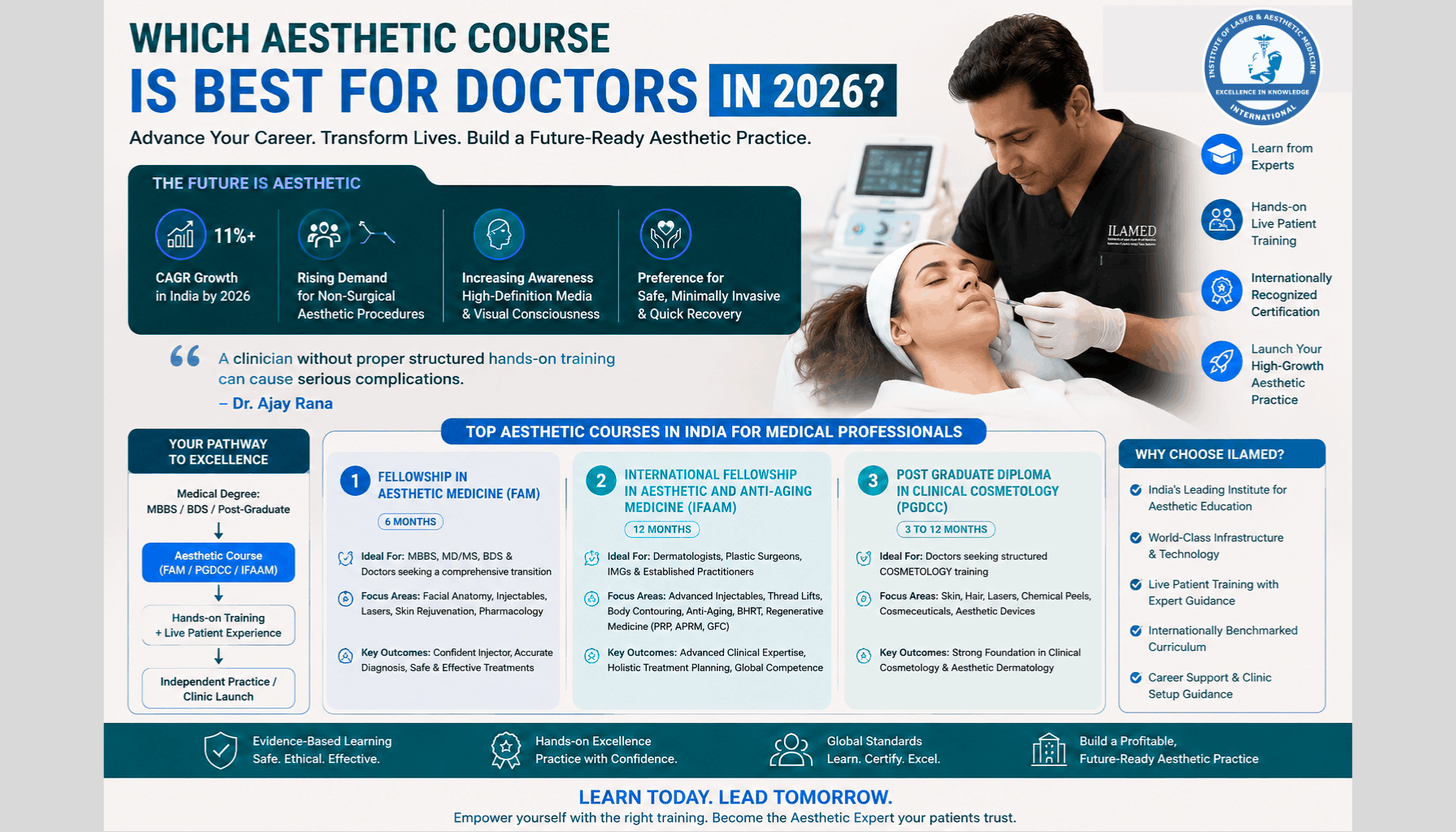
There is no “one-size-fits-all” model for aesthetic education. Programs are structured systematically to match the doctor’s previous medical background, future career plan, and training time. An analytical list of the best clinical courses available for doctors interested in pursuing aesthetic courses in India is presented below.
text
Medicines Degree: MBBS / BDS / Post-Graduate
│
┌────────────────┴────────────────┐
▼ ▼
All materials in this publication are subject to copyright protection.
– FAM (6 Months) – PGDCC (3-12 Months)
Programme CERTIFICATIONS: – IFAAM (1 Year Masterclass) – Specialized Masters (Trichology/Gynec)
│ │
└────────────────┬────────────────┘
▼
This is a model that combines theory and hands-on activities.
│
▼
Independent Practice / Clinic Launch
1. Fellowship in Aesthetic Medicine (FAM)
It is believed that the Fellowship in Aesthetic Medicine (FAM) is the benchmark for all physicians that enter the field of medical aesthetics. The course is designed to take a traditional medical school graduate and turn him/her into a self-assured aesthetic injector and laser clinician, and the course lasts for 6 months.
Target Audience: It is an ideal book for all those practicing in core clinical fields, like MBBS graduates, MD/MS specialists and those who need a fast and yet comprehensive transition plan.
Core Curriculum Focus: The program provides core competency in facial anatomy, skin pharmacology, the physics of light-based devices, and non-surgical skin rejuvenation.
Key Educational Outcomes: Delegates work clinically with mapping injection points, calculation of accurate dosages, product rheology (the flow and thickness of dermal fillers) and diagnostic skin evaluations.
2. International Scientific Communication Skills (ISC) Program / International Fellowship in Aesthetic and Anti-Aging Medicine (IFAAM)
The International Fellowship in Aesthetic and Anti-Aging Medicine (IFAAM) is the most prestigious master level course for medical professionals looking to make a name at the pinnacle of the market. This 12-month accelerated programme combines both surface and internal metabolic healing.
Target Audience: Any already established medical practitioner, dermatologist, plastic surgeon or international medical graduate (IMGs) looking to qualify for the best possible qualification in the world.
Core Curriculum Focus: Advanced injectables, multi-vector thread lifting, body contouring systems, preventive anti-aging medicine, bio-identical hormone replacement therapies (BHRT), and cellular regeneration techniques (APRM, advanced platelet-rich plasma and growth factor concentrates) are all deeply covered in the Core Curriculum Focus.
Key Educational Outcomes: Learners develop multi-layered, complex facial transformations and the ability to design in depth, holistic, internal-to-external wellness routines for an elite clientele.
3. PG Diploma in Clinical Cosmetology (PGDCC)
It is a very structured course and the Postgraduate Diploma in Clinical Cosmetology (PGDCC) places a strong emphasis on high level dermatology treatments and non-surgical medical skin care technologies.
Target Audience: The candidates who want to pursue their career as clinical skin specialists and in advanced chemical peeling and medical device operations are eligible for this course.
Core Curriculum Focus: Intensive study of chemical resurfacing (superficial to deep peels), micro-needling radiofrequency (MNRF), high-intensity focused ultrasound (HIFU), laser scar management and tattoo removal.
Key Educational Outcomes: Knowledge of epidermal and dermal rejuvenation protocols, accurate calibration of the devices for different Fitzpatrick skin types and long term management of chronic pigmentation disorders.
Comparative Matrix of Leading Educational Pathways
The table below is a comparison of the main parameters of the structures of the top aesthetic courses in India for 2026 in order to guide your planning for the future.
| Course Name | Duration | Primary Clinical Focus | Hands-On Training Model | Eligibility Requirements |
| Fellowship in Aesthetic Medicine (FAM) | 6 Months | The basic peel, lasers, dermal fillers and botulinum toxins are the most common treatments. | Theory and practical sessions are delivered in a blended format (online and intensive on campus) | MBBS, MD, MS, BDS (Limited Scope) |
| International Fellowship in Aesthetic & Anti-Aging Medicine (IFAAM) | 1 Year | Advanced Structural Injectables, Thread Lifts, BHRT, Cellular Anti-Aging | Extended On-Campus Residency + Live Patient Injection Mentorship | Registered Medical Graduates (MBBS/MD/MS) |
| Postgraduate Diploma in Clinical Cosmetology (PGDCC) | 3 to 12 Months | Medical Trichology, Chemical Resurfacing, Light Based Device Therapy | On-site Clinical Rotations & Live Case Demonstrations | Students who have passed out from MBBS, BDS, BAMS, BHMS and Nursing graduate courses are also eligible to apply. |
| Fellowship in Aesthetic Dentistry (FAD) | 3 Months | The smile design, veneers, perioral botox, nasolabial fillers are all done by this solution. | Specialized Clinical Practical Labs in Focused Maxillofacial & Dental Clinical Practical Labs | The courses are BDS/MDS (Registered Dental Practitioners). |
What is expected of a Medical Aesthetic Program
Any high quality aesthetic program is based on a strong, science-based curriculum. It should far exceed product demonstrations to provide core medical training. The basic requirements of any quality course are:
Identify the various parts of the face and how they change with age.
So it’s important to have a deep, three-dimensional knowledge of facial architecture when practicing aesthetic medicine. The training should include a complete plan for:
- The Significance of Facial Fat Compartments: Superficial and deep fat compartments, and the understanding of how loss of volume in these areas contributes to the facial “sagging” and “aging” effect.
- Muscular Mechanics: Understanding the exact origins, insertions and deep vs superficial profiles of the muscles of the face, including the frontalis, orbicularis oculi, and procerus, to achieve a truly natural appearance when injected with botulinum toxin.
- Vascular Highways: Creating a very accurate mental map of the important arterial flow (facial, angular and supratrochlear) so that there is no accidental intra-arterial product placement.
The Facial Layering System for Safe Injection Placement
A technique for placement that ensures safety for the face and neck.
text
┌────────────────────────────────────────────────────────┐
│ Layer 1: Skin (Epidermis & Dermis) │
├────────────────────────────────────────────────────────┤
│ LAYER 2: Superficial Fat Pads (Subcutaneous Space) │
├────────────────────────────────────────────────────────┤
│ The SMAS (Superficial Muscular Aponeurotic System) │
│ is at the third layer. │
├────────────────────────────────────────────────────────┤
│ Structural Volume: Layer 4 Deep Fat Pads │
├────────────────────────────────────────────────────────┤
│ Safe Depot Zone: Periosteum (Bone Surface) │
└────────────────────────────────────────────────────────┘
Advanced Injectables Pharmacology and Rheology
Physicians need to take a prescription drug course to learn how to manage injectables with great skill; they need to be able to accurately evaluate:
- Botulinum Toxin Dynamics: The exact science of how to reconstitute Botulinum Toxin, calculate the units, how it travels through the body and where to inject it in order to treat dynamic rhytids (wrinkles).
- Dermal Filler Chemistry: Understanding the precise molecular cross-linking structures of HA fillers. Practitioners need to be aware of the difference between using high G-Prime filler for structural jawline contouring and low G-Prime filler for perioral or tear trough hydration.
The Physics of Energy Based Devices
Laser technologies are the mechanical pillars of today’s aesthetic clinic. Comprehensive programs shall be designed to teach:
- Laser-Tissue Interactions: The basics of wavelength selection, pulse width, spot size and energy fluence.
- Hands-on training with a variety of Class 4 medical lasers, including Q-Switched Nd:YAG laser for pigment and tattoo removal, Fractional
- CO2
- CO
- 2
-
- for deep acne scar remodeling and Diode laser for long-term laser hair reduction.
Legal Scope and Professional Eligibility in India
Safeguarding your medical license amidst the legal structure is absolutely crucial to maintaining the best ethical standards. The scope of practice in India depends on the recognition of your primary medical qualification and the guidelines issued by the national councils (e.g., Dental Council of India, National Medical Commission).
MBBS, MD and MS Practitioners
Physicians who possess an NMC registered MBBS degree and/or a higher post-graduate medical qualification/degree have full legal authority to practice the full range of medical aesthetics. This involves the use of medical grade topical formulations, the use of advanced Class 4 energy based devices, multi-layer thread lifts and the injection of deep dermal fillers and botulinum toxins in all facial and body anatomical zones.
Dentist in the field of Dentistry, BDS and MDS Dental Surgeons
Dentists are fully qualified to pursue advanced specialties such as the Fellowship in Aesthetic Dentistry (FAD) or Fellowship in Advanced Aesthetic Dentistry (FAAD) at a place like ILAMED.
The scope of practice of a dental surgeon as per the law is very limited and has a primary emphasis on the maxillofacial, perioral and oral area. In this context, dentists can truly excel in managing gummy smiles, addressing jaw muscle enlargement (masseter hypertrophy) associated with bruxism (teeth grinding), refining nasolabial folds, and creating holistic smile transformations that integrate dental aesthetics with facial harmony.
AYUSH and Nursing Professionals
Students from AYUSH pathways (BAMS, BHMS) and B.Individuals with Nursing background are encouraged to take up Clinical Cosmetology and Trichology courses to enhance their knowledge immensely.
From a legal perspective, their practice is mostly concerned with treatments in the surface layers of the skin. These are advanced medical facials, superficial chemical peels, micro-needling, and assistance in or operating certain light and/or radiofrequency devices under direct medical supervision. Most of them are not allowed to do deep facial injections, such as dermal fillers, or botulinum toxins.
Absolute necessity for live-patient training
It is impossible to gain all the clinical skills one needs through a computer screen, from a textbook or from watching a video demonstration. High-quality schools such as ILAMED focus on practical, experiential learning with supervision. Dr. Ajay Rana and other senior faculty and industry experts provide mentorship to the delegates which carry out procedures on a live patient. This direct clinical environment helps doctors learn to measure skin resistance precisely, deal with the feedback from patients in real time, understand the skin responses immediately and master the physical contact needed for precision injection.
A detailed strategy for minimizing complications
The truly skilled aesthetic physician is not only adept at creating beautiful outcomes he is also fast and proficient at what he does when things go wrong. Good training sessions invest significant time in imparting correct rescue procedure so that doctors can confidently deal with:
- Vascular Occlusion Interventions: An immediate arterial blockage may be detected by observing the change in color of the skin, and if there is significant localized pain, the procedure can be carried out immediately, using high doses of hyaluronidase to dissolve the blockage and restore healthy blood flow.
- Adverse Soft-Tissue Management: Prevention and treatment of delayed-onset nodules, localized infections, post-inflammatory hyperpigmentation (PIH) and transient edema (swelling) or erythema (redness).
Career Pathways and Financial Projections After Certification
Upon completion of a premier certification, a variety of promising and lucrative career opportunities can be found throughout the healthcare sector.
1. Corporate Medical Aesthetics & High Quality Clinic Chains
Well-trained aesthetic physicians are in demand on the institutional market. Graduates can typically find jobs as consultant aesthetic doctors or clinical directors at top-tier, nationwide anti-aging wellness chains and luxury medical spas.
2. Independent Practice and Private Clinic Ownership
For clinicians who want to be entrepreneurs, the fellowship program is just what they need to build that clinical confidence and technical expertise needed to start their own private practice. This route provides full professional freedom, the opportunity to design your own patient experience, and great control of your own work-life balance.
3. Financial Trajectory and Return on Investment (ROI)
The monetary returns in medical aesthetics are tied to the amount of clinical experience you have and how your hands-on skills have been refined, as well as your overall market positioning. The table below provides a realistic estimation of incomes for certified aesthetic doctors in the Indian market in 2026, based on data.
IPMIX: Independent Practice Monthly Income Trajectory by Experience Level
text
Senior (5+ Years) │ ▓▓▓▓▓▓▓▓▓▓▓▓▓▓▓▓▓▓▓▓▓▓▓▓▓▓▓▓▓▓▓▓▓▓▓▓▓▓▓▓ ₹10 – ₹25 Lakhs
│
Mid-Level (2-4 Yrs) │ ▓▓▓▓▓▓▓▓▓▓▓▓▓▓▓▓ ₹4 – ₹8 Lakhs
│
Fresher (0-1 Year) │ ▓▓▓▓ ₹1.5 – ₹3 Lakhs
└─────────────────────────────────────────────────────────
₹0 ₹2L ₹4L ₹6L ₹8L ₹10L ₹15L ₹20L ₹25L (INR)
| Professional Tier & Experience Level | Average Monthly Salary (Corporate/Chain Clinics) | Estimated Monthly Income (Self-Employment) |
| Entry-Level Practitioner (0-1 Year Post-Certification) | ₹~60,000 to ₹~90,000 | ₹~1,50,000 to ₹~3,00,000 |
| Mid-Level Consultant (2-4 years of active clinical practice) | ₹~1,20,000 to ₹~2,00,000 | ₹~4,00,000 to ₹~8,00,000 |
| Senior Specialist / Practice Owner (5+ Years of Dedicated Industry Authority) | ₹~2,50,000 to ₹4,00,000+ | ₹~10,00,000 to ₹~25,00,000 |
To choose an Ideal Aesthetic Training Institute, you need to complete the following checklist
This handy 5-point checklist can be used to comprehensively assess any training institute before joining the best aesthetic courses in India:
- Check the longevity of the institution and its industry representation: If it’s an institution that’s been around for more than two decades, like the ILAMED, it’s likely that it has a solid track record that ensures you are learning from a stable program.
- Audit Faculty Training and Leadership: Ensure that the program is taught and led by a leader and/or expert in the field of medicine, with medical qualifications, who is actively practicing Medicine in the world, not a person with no medical qualifications.
- Confirm the Practical Training Model: Make the Practical Training Model explicit. Be sure you will be performing and treating live patients and not just watching dummy models or watching videos.
- Verify Accreditation: Ensure that your end qualifications are officially recognized by reputed international bodies like the Indo-German Board of Aesthetic Medicine and Surgery (IGBAMS) or those affiliated with the International Union of Aesthetic Medicine (UIME).
- Assess Post-Training Support Systems: Ensure that the institute offers post-training support such as continued mentoring, continuous medical education (CME) training, and practical advice on clinic setup, equipment purchase, and patient retention.
Taking Your Next Step: Conclusion
For modern doctors in 2026, the decision to pursue a career in medical aesthetics is an incredibly promising and future-proof trajectory to take. You will protect your professional reputation and ensure long-term financial success by selecting a comprehensive program that has just the right mix of strong scientific theory and real-world, live-patient application.
For those seeking to make a leap in their professional journey, ILAMED’s world-class, internationally accredited fellowship opportunities are available under the leadership of visionary Dr. Ajay Rana. Take your medical practice to new heights, cater to the growing demand of today’s patients and stay at the very top of the medical aesthetic industry in India.
Frequently Asked Questions (FAQ)
Is it legal to get Botox and dermal fillers from an ordinary MBBS doctor in India?
Yes. An MBBS doctor registered with the National Medical Commission (NMC) or the medical council of the state is legally allowed to do injectables such as fillers and botulinum toxins. But these are the high-tech procedures which are not taught as part of the regular MBBS course; so it is highly recommended for patients’ safety and to gain the real competency to perform these procedures through a thorough and structured clinical training.
Is a cosmetology certificate different from a medical fellowship?
The typical cosmetology certificate is geared more towards cosmetology that can be performed by non-medical professionals and are mostly superficial, skin-focused treatments delivered in a salon setting. A medical fellowship is an advanced, science-based clinical training program that is specifically geared toward the registered healthcare professional and typically granted to physicians or other healthcare professionals. It includes the in-depth anatomy and facial regions, prescription level pharmacology, advanced injectable procedures and medical management of complications.
On average how long does it take to become an independent aesthetic practitioner?
Intensive hands-on courses can last anywhere from 3 months to a year; after a doctor has been actively practicing, he should be a confident, independent practitioner within 6 months after his formal certification. The process will be further expedited with continued mentorship and attendance at advanced masterclasses.
Do aesthetic training courses on a computer alone adequately prepare one to begin a private practice?
Yes. For learning important and basic theoretical background, understanding of laser physics, and learning structural anatomy, online modules are highly efficient and excellent. But there is no substitute for learning the skills which rely on the hands-on experience of a classroom or lab. Before you can risk working on patients safely in your own clinic, it is absolutely essential that you have hands-on experience with real patients, while working directly under the supervision of an expert.