
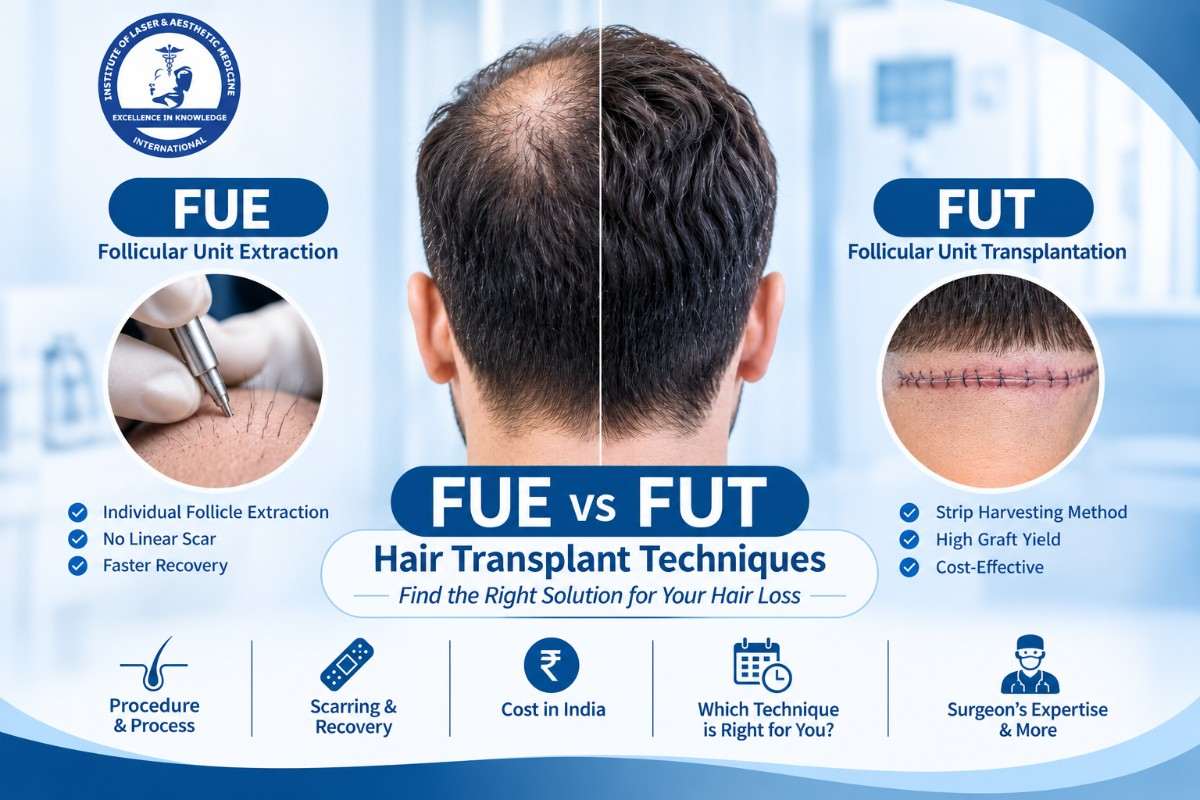
FUE vs FUT hair transplant techniques – an overview
Guiding questions: What are FUE and FUT, and how do these two hair transplant techniques fundamentally differ in their approach to harvesting donor hair? What other hair surgery types exist alongside them?
Expert insights: Clarify that FUE and FUT differ chiefly in donor harvesting method, not in how grafts are implanted. Introduce the broader landscape of hair surgery types (FUT strip method, FUE, DHI as an FUE variant, robotic-assisted extraction) so readers understand where each technique fits before deeper sections explain them individually. Emphasise that both aim for natural, permanent results but suit different clinical scenarios.
FUT meaning and how the strip procedure works
Guiding questions: What does FUT stand for, and what are the step-by-step stages of follicular unit transplantation surgery?
Expert insights: Explain FUT (follicular unit transplantation) as the strip harvesting method – a linear strip of scalp is removed from the donor area, dissected under microscopy into individual follicular units, and these are implanted into recipient sites. Cover anaesthesia, strip width, and why this method allows surgeons to harvest a large number of grafts in a single sitting.
FUE vs FUT Hair Transplant Techniques: Comparing Hair Surgery Types
FUE (Follicular Unit Extraction) and FUT (Follicular Unit Transplantation) are the two core surgical hair restoration techniques, differing mainly in how donor hair is harvested rather than in how it is implanted. FUE removes follicles one at a time through tiny punches, leaving scattered dot scars and a comparatively quick recovery, while FUT removes a strip of scalp for dissection under a microscope, enabling very high graft counts in a single sitting with a thin linear scar. Direct hair implantation (DHI) and robotic-assisted extraction are modern variations built on the FUE approach. The right technique depends on the extent of hair loss, donor density, hair type and the patient’s lifestyle preferences.
Anyone exploring hair restoration eventually faces the same decision: FUE or FUT? The two surgery types promise similar long-term results but follow very different paths to reach them, from the way grafts are harvested to how visible the aftermath remains. This guide compares the mechanics, scarring, recovery, cost and suitability of each approach, so that the choice rests on informed judgement rather than guesswork.
FUE vs FUT hair transplant techniques – an overview
FUE and FUT are the two foundational hair transplant techniques used to treat pattern baldness, and they differ chiefly in how donor hair is harvested rather than in how the grafts are finally placed. Follicular Unit Extraction lifts individual follicular units one at a time from the scalp using a fine punch tool, whereas Follicular Unit Transplantation, also called the strip method, removes a single strip of donor tissue that technicians later divide into grafts under magnification. Once harvested, grafts from either technique are inserted into recipient sites according to the same basic implantation principles, so the real divergence lies entirely at the donor-harvesting stage.
Image suggestion: An illustrative scalp diagram comparing two donor-area harvesting patterns used in hair restoration.
Beyond these two core techniques, the wider landscape of hair surgery types includes a few notable variations:
- FUT (strip method): a linear strip of donor scalp is excised and dissected into grafts.
- FUE: individual follicles are extracted one by one through a micro-punch, leaving no strip wound.
- DHI: an FUE variant that uses a pen-like implanter to extract and place follicles in close succession.
- Robotic-assisted extraction: image-guided systems that standardise how grafts are selected and removed during FUE.
Each of these variants belongs to the FUT or FUE family rather than forming an entirely separate surgical category. All of them aim to deliver permanent, natural-looking hair growth, because the transplanted follicles originate from areas that are genetically resistant to balding. Where they differ is in the clinical scenario each suits best: FUT tends to favour sessions requiring very large graft numbers, while FUE and DHI often suit patients who prefer short hair or a faster recovery. Readers wanting a deeper breakdown of how these hair surgery types compare can consult ILAMED’s detailed overview of hair restoration techniques.
FUT meaning and how the strip procedure works
FUT stands for follicular unit transplantation, a technique built around removing a single continuous strip of scalp from the donor zone rather than extracting follicles individually. The procedure begins with local anaesthesia applied to the back and sides of the scalp, after which the surgeon excises a thin strip of tissue, typically narrow enough for the wound edges to be brought together without excessive tension.
Once removed, the strip passes to a team of technicians who divide it under microscopic magnification into individual follicular units, each containing one to four hairs along with its surrounding tissue. This microscopic dissection allows grafts to be separated cleanly while the follicles remain intact and well protected throughout handling. The donor wound is then closed, often with a trichophytic technique that encourages hair to grow through the healed line and camouflage it.
Because the strip yields a continuous block of donor tissue rather than scattered individual punches, FUT enables a surgical team to harvest a very large number of grafts within a single sitting without moving repeatedly across the donor area. This makes it a practical option when a patient’s hair loss calls for extensive coverage and when minimising total surgical time matters more than avoiding a linear scar. The subsequent implantation stage, in which grafts are placed into the recipient area, mirrors the process used after FUE harvesting, since both techniques converge at this point in the procedure.
What is FUE hair treatment and how it works
FUE hair treatment, short for follicular unit extraction, is a method of harvesting donor hair one follicular unit at a time with a small circular micro-punch instead of removing a strip of tissue. The surgeon rotates the punch around each follicular unit to separate it from the surrounding scalp, then lifts it out with fine forceps before it is implanted into the thinning or balding recipient area.
A typical FUE session follows a structured sequence: consultation and hairline planning, trimming of the donor area, administration of local anaesthesia, extraction of follicular units across the back and sides of the scalp, and finally implantation into pre-made recipient sites. As no strip of skin is removed, there is no incision to close and therefore no need for stitches, which is one of the defining practical advantages of FUE hair treatment over the strip method.
Two notable variants build directly on standard FUE. Direct hair implantation (DHI) uses a pen-like implanter that holds the extracted graft and inserts it into the scalp in a single motion, combining site creation and placement into one step instead of pre-making recipient sites in advance. Robotic FUE systems, such as the ARTAS platform, employ image-guided cameras and a robotic arm to help identify, select and extract healthy follicular units at a consistent angle and depth, reducing some of the variability inherent in manual technique.
Image suggestion: The ARTAS-type robotic system used for image-guided follicle extraction during FUE procedures.
Surgeons training in these extraction methods typically develop their skill through structured, hands-on practice rather than relying on equipment alone; programmes such as the International Fellowship in Trichology and Hair Transplant cover both manual and motorised extraction approaches in supervised clinical settings.
FUE hair grafts – extraction process and graft quality
FUE hair grafts are removed one at a time through what is often described as a blind-punch technique, meaning the surgeon judges the angle and depth of each follicle beneath the skin without directly visualising its full path before extraction. This reliance on estimation, repeated hundreds or thousands of times in a session, is the main reason FUE carries a comparatively higher transection risk than FUT, transection being damage to or severing of part of the follicle during removal.
In FUT, grafts are dissected from the strip under direct microscopic view, so technicians can see each follicular unit clearly and separate it from surrounding tissue with greater precision, which generally keeps transection rates below those typically reported for blind FUE punches. Graft survival nonetheless depends heavily on how quickly follicles move from extraction to implantation and how well they are kept hydrated and chilled during that window. This handling step matters for both techniques but carries slightly more consequence in FUE, given the larger number of individual extraction wounds involved.
The two approaches also manage session size differently. So-called giga sessions, covering 4,500 to 6,000 or more grafts in one sitting, are typically built by combining methods rather than relying on a single technique:
- FUT portion: roughly 2,500 to 3,500 grafts harvested from a single strip, depending on scalp laxity.
- FUE portion: an additional 2,000 to 3,000 grafts taken from the scalp around the strip scar or elsewhere on the donor area.
- Beard or body hair: extra grafts drawn from facial or body hair when scalp donor supply runs short.
This layered approach allows surgeons to extend the total usable graft count well beyond what either technique could safely deliver alone in a single session, while still respecting the extraction limits each method imposes on donor tissue.
Which technique leaves less scarring – FUE or FUT
For most patients, FUE leaves noticeably less visible scarring than FUT, particularly for those who wear their hair very short. FUT scarring takes the form of a single linear line across the back of the scalp, where the donor strip was removed and the edges sutured together. This line can be minimised through a trichophytic closure technique, which allows hair follicles at the wound edge to grow through the scar and partially disguise it, yet the scar remains a fixed, continuous mark rather than disappearing entirely.
FUE, by contrast, leaves many tiny, scattered dot scars across the donor area, each corresponding to a single punch site. Because they are spread out rather than concentrated along one line, these dots are generally far less noticeable than a linear scar, and they tend to blend into the surrounding scalp skin even under close inspection.
| Feature | FUT | FUE |
| Scar pattern | Single linear scar | Multiple small dot scars |
| Visibility with very short hair | Can show under a close crop | Rarely noticeable |
| Concealment approach | Trichophytic closure, longer hair over the area | Scars are small enough to need little concealment |
This difference matters most for patients considering their future hairstyles. Someone who intends to keep the hair over the donor area at a longer length may never notice a FUT scar in daily life, whereas someone who prefers a close buzz cut or shaved look is far more likely to see it. FUE scarring, being scattered rather than linear, tends to remain unobtrusive however short the surrounding hair is cut, which explains why it is often favoured by patients who do not want surgical history to constrain their hairstyle choices.
How painful is FUE hair transplant compared to FUT
Both FUE and FUT are performed under local anaesthesia, so once the initial numbing injections take effect, discomfort during the operation itself is minimal for either technique. The meaningful difference in pain emerges afterwards, when the anaesthesia wears off and the body begins to heal.
FUT patients commonly report tightness and soreness along the donor strip site, a natural consequence of the incision and sutures drawing the scalp together under some tension. This discomfort can persist for several days and is sometimes more pronounced when bending forward or lying down. FUE patients, in contrast, typically describe a milder, more diffuse discomfort spread across the many small puncture points rather than concentrated along one line, which most people find easier to manage.
In both cases, oral analgesics prescribed by the surgeon are usually sufficient to control post-operative discomfort, and severe pain is uncommon with either technique when the procedure is performed competently. Whichever method they choose, patients should expect some manageable soreness rather than an entirely pain-free recovery.
Recovery time after FUT surgery versus FUE
Recovery after FUT surgery generally takes longer than after FUE because the sutured donor wound needs time to heal and settle. Most surgeons schedule suture or staple removal around ten to fourteen days after the procedure, and patients are typically advised to avoid activities that stretch or strain the scalp during this period in order to protect the healing strip line.
FUE recovery tends to progress more quickly, since there is no incision to close. The many small puncture wounds form scabs that usually flake away within several days to about a week, revealing the healing punch sites beneath without any follow-up visit to remove stitches.
| Recovery milestone | FUT | FUE |
| Stitches or staples | Required, removed around 10-14 days | Not required |
| Visible scabbing resolves | Gradually over the healing period | Within several days |
| Return to desk-based work | Often within a few days, with some discomfort | Often within a few days, generally more comfortable |
Both techniques require patience before physical activity is resumed. Light walking is usually acceptable early on, but strenuous exercise, swimming and activities that cause heavy sweating are typically postponed for a few weeks to protect the healing scalp and newly placed grafts, with FUT patients often advised to wait somewhat longer because of the donor incision. Shaving the recipient area is avoided until the surgeon confirms that the grafts have settled, while the FUE donor area, having been trimmed before the procedure, simply grows back naturally over the following weeks.
Cost difference between FUE and FUT in India
Across Indian clinics, FUE generally costs more per graft than FUT, largely because of the longer surgical time, the specialised extraction skill the blind-punch technique demands, and the smaller number of grafts that can be safely harvested per hour compared with strip dissection. Clinic pricing commonly places FUT in a lower per-graft band than FUE for the same graft count, although both techniques can vary considerably depending on where the procedure is performed.
| Technique | Typical per-graft range in India | What drives the price |
| FUT (strip method) | Often the lower end of the per-graft scale | Faster harvesting, less specialised extraction labour |
| FUE | Generally priced higher per graft than FUT | Longer operative time, skilled manual or robotic extraction |
A higher per-graft rate does not, however, always make FUE the more expensive option overall. For very large graft requirements, FUT can prove more economical in total because it harvests efficiently in bulk, whereas pushing FUE to the same graft count often means a longer session or an additional sitting, which adds to the final bill.
Several factors shape the exact quote a patient receives. A clinic’s reputation and the surgeon’s personal experience tend to influence pricing meaningfully, as does the city in which the clinic operates, with prices in major metros often higher than in smaller towns owing to overheads and demand. Robotic-assisted extraction typically adds a premium over manual FUE because of the equipment and specialised operation involved. Finally, the total number of grafts required for a patient’s degree of baldness remains the single biggest driver of the final cost, since pricing is almost always calculated per graft rather than as a flat procedure fee.
Can FUE be repeated multiple times for more grafts
FUE can generally be repeated in subsequent years, provided the donor area retains enough density to support further safe extraction. This makes it a practical option for patients whose hair loss continues to progress after an initial session, or for those seeking a touch-up to increase density in a previously treated area, since each new session can target follicles left unharvested the first time.
How much repeat FUE remains possible depends entirely on how much donor hair is left and how thinly it has already been harvested; a donor area pushed close to its safe limit in one sitting leaves less room for a comfortable second round without risking visible thinning at the back of the scalp.
For patients with extensive baldness and a limited scalp donor supply, combining FUT and FUE within the same treatment plan is a common way to maximise total graft availability. A surgeon might harvest a strip through FUT to secure a large block of grafts, then supplement that count with FUE extraction from the surrounding scalp and, in more extensive cases, draw additional grafts from beard or body hair.
This layered strategy is generally reserved for patients with significant baldness who wish to achieve as much coverage as possible, as body and beard hair are usually regarded as a secondary source, used only once scalp donor hair has been exhausted. Readers wanting to understand how these combined strategies fit into formal clinical training can explore ILAMED’s hair transplant course resources.
Choosing the right technique for your hair loss pattern
The choice between FUE and FUT depends on a combination of factors: the extent of hair loss, how much donor density remains, the patient’s hair type, and lifestyle preferences regarding hairstyle and downtime. No single technique suits every candidate, which is why a personalised assessment of the scalp usually precedes the final recommendation.
- Extent of baldness: extensive hair loss requiring very high graft numbers often favours FUT for its efficient bulk harvesting.
- Hairstyle preference: patients who want very short hairstyles or shaved looks tend to favour FUE for its far less visible scarring.
- Scalp laxity: limited scalp elasticity can make strip removal difficult, pushing some patients toward FUE instead.
- Downtime tolerance: those wanting minimal recovery disruption often lean toward FUE’s faster healing.
- Hair type: curly or coarse hair can raise the transection risk during FUE extraction, since the follicle’s curved path under the skin is harder to judge accurately with a punch tool.
- Willingness to shave: patients unwilling to shave their head, including many women seeking hair restoration, often prefer FUT since it does not require trimming the donor area.
In practice, many surgeons weigh these factors together rather than applying a single rule, and the same patient may be a reasonable candidate for either technique depending on which priority matters most to them. For a deeper look at how these considerations shape professional training in both techniques, ILAMED’s guide to hair transplant training courses breaks down the practical trade-offs surgeons learn to navigate.
Surgeon training and skill in FUE and FUT procedures
Surgeon training and hands-on skill are critical to minimising graft transection in both FUE and FUT, because outcomes in either technique depend far more on dexterity and structured practice than on the instrument used. A poorly trained hand can damage grafts and leave avoidable scarring with either method, whereas a well-trained one can achieve clean, low-transection results even with basic equipment.
Image suggestion: A hands-on clinical training session where doctors practise extraction and implantation technique under supervision.
- Hands-on certification: verify the surgeon has completed structured, supervised training in extraction, dissection and implantation rather than brief observation alone.
- Case volume: ask how many FUE and FUT procedures the surgeon has personally performed, not merely supervised.
- Documented results: request before-and-after examples from cases with a similar hair loss pattern to your own.
- Who performs each step: confirm whether the surgeon personally handles extraction and implantation or delegates these steps to technicians.
Fellowship-style training that covers extraction, dissection and implantation in a structured, hands-on format builds the precision both techniques demand, since reading about a procedure and performing it under supervision represent very different levels of preparation. Clinicians and surgeons seeking to build or refine this expertise through structured, accredited practice can review ILAMED’s hands-on hair transplant training programmes to compare FUE and FUT training pathways before choosing a course.
Ultimately, neither FUE nor FUT is universally superior. Each is a well-established route to natural, permanent hair restoration when carried out by a properly trained hand, and the right choice comes down to matching the technique to the patient’s donor supply, hair type and lifestyle rather than pursuing a single “better” option.
Guiding questions: What is FUE hair treatment, how does the extraction and implantation process unfold, and how do DHI and robotic FUE relate to it?
Expert insights: Describe follicular unit extraction as individual-follicle harvesting using a micro-punch tool, without removing a strip of tissue. Mention DHI (direct hair implantation) as an FUE variant using an implanter pen for simultaneous extraction and placement, and robotic FUE systems (such as ARTAS-type devices) that improve extraction precision and consistency. Note typical session structure and why no stitches are needed.
FUE hair grafts – extraction process and graft quality
Guiding questions: How are FUE hair grafts extracted and handled, and how does graft yield and transection risk compare with FUT grafts?
Expert insights: Detail the blind-punch extraction method used in FUE and why it carries a higher transection (graft damage) risk compared to the direct microscopic dissection used in FUT, where grafts are visually separated and better protected. Discuss graft survival rates, storage handling, and how session size (giga sessions of 4500-6000+ grafts) is managed differently between the two techniques.
Which technique leaves less scarring – FUE or FUT
Guiding questions: Which technique leaves less scarring, FUE or FUT, and why does this matter for hairstyle choices?
Expert insights: Contrast the linear scar left by FUT (which can be minimised using trichophytic closure to blend hair growth through the scar line) against the tiny, scattered dot scars left by FUE punch sites, which are far less noticeable even with very short haircuts. Note that FUT scarring matters more for patients who keep short hair, while FUE scarring is rarely visible regardless of hairstyle.
How painful is FUE hair transplant compared to FUT
Guiding questions: How painful is FUE hair transplant compared to FUT during and after the procedure?
Expert insights: Explain that both techniques use local anaesthesia so intra-operative discomfort is minimal, but post-operative sensation differs – FUT patients may feel more tightness and soreness along the strip site, while FUE patients typically report milder, more diffuse discomfort across numerous small puncture points. Mention pain management with oral analgesics in both cases.
Recovery time after FUT surgery versus FUE
Guiding questions: What is the recovery time after FUT surgery compared to FUE, including suture care and return to normal activity?
Expert insights: Outline that FUT requires suture or staple removal around 10-14 days post-surgery and a longer period of restricted activity to protect the donor strip, whereas FUE heals faster since there are no stitches, with most visible scabbing resolving within days. Address when patients can typically resume exercise, swimming and shaving after each technique.
Cost difference between FUE and FUT in India
Guiding questions: What is the cost difference between FUE and FUT in India, and what factors influence per-graft pricing?
Expert insights: Explain that FUE generally costs more per graft than FUT in India because of the longer surgical time and specialised extraction skill required, even though FUT can be more economical for very large graft requirements. Cover how per-graft pricing varies by clinic reputation, city, surgeon experience, use of robotic technology, and graft quantity needed for the patient’s degree of baldness.
Can FUE be repeated multiple times for more grafts
Guiding questions: Can FUE be repeated multiple times over the years, and how does this compare with combining FUT and FUE for advanced baldness?
Expert insights: Confirm that FUE sessions can generally be repeated in subsequent years as donor density allows, making it useful for progressive hair loss or touch-up sessions. Explain how a combined FUT-plus-FUE approach, and in some cases body or beard hair extraction, helps maximise total graft availability for patients with extensive baldness and limited scalp donor supply.
Choosing the right technique for your hair loss pattern
Guiding questions: Which candidates are best suited to FUE versus FUT based on hair loss extent, donor hair density, hair type and lifestyle?
Expert insights: Guide readers through practical selection factors – extensive baldness with high graft needs often favours FUT, while patients preferring short hairstyles, those with limited scalp laxity, or those wanting minimal downtime often favour FUE. Note that curly or coarse hair types can raise transection risk in FUE, and that patients unwilling to shave their head (including many women) may prefer FUT.
Surgeon training and skill in FUE and FUT procedures
Guiding questions: Why does surgeon training and hands-on skill matter for minimising graft transection, and how can a patient assess a surgeon’s qualification before choosing a technique?
Expert insights: Highlight that outcomes in both FUE and FUT depend heavily on surgeon dexterity and structured clinical training, not only on the technology used – inadequately trained hands increase transection rates and scarring regardless of instrument. Advise patients to check a surgeon’s hands-on certification, case volume and documented results, and note that structured fellowship-style training in extraction, dissection and implantation builds the precision both techniques demand.