Introduction
Hair loss is one of the most prevalent issues that occur in millions of Indians today. Whether it’s young professionals in their twenties or patients in their forties, the need for effective, lasting hair restoration treatments has never been greater. At the heart of that demand is one of the most coveted surgical techniques in contemporary aesthetic medicine: hair transplantation.
Hair transplant training in India is gaining significance as it is a rapidly growing medical field, and doctors and medical professionals are increasingly making this choice as a career path. If you are a general practitioner interested in new specialties, a dermatologist seeking to expand your medical practice into surgery, or a plastic surgeon seeking practical learning to master surgical techniques — a targeted FUE/FUT hair transplant course might afford you some exciting career options.
In this guide, you will get to know everything about FUE and FUT, who can avail of training, what does it involve, what is the scope of the career and where to get the best hair transplant training in India.
Hair Transplant Surgery : What You Should Know About The Procedure. FUE vs FUT Explained
It is essential to have an understanding of the two basic techniques that are being taught in all hair transplant courses before enrolling in a training program.
FUE — Follicular Unit Extraction
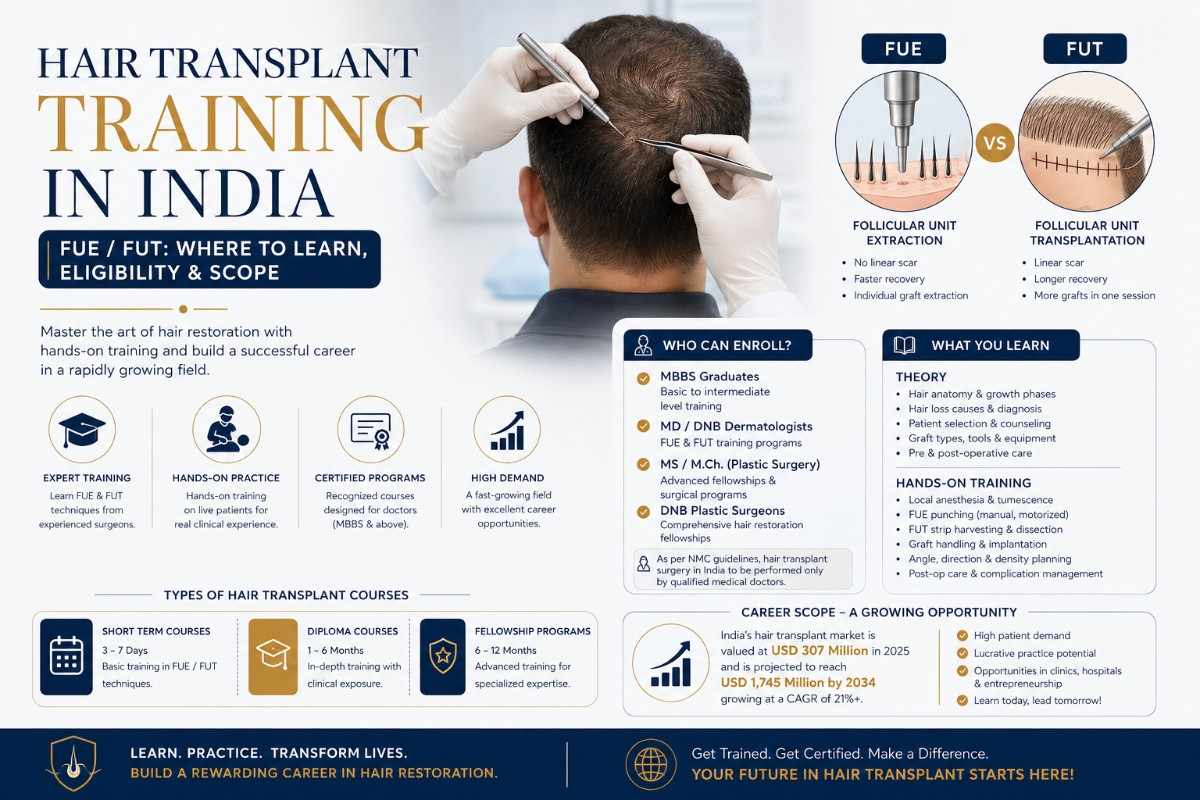
The most popular hair transplant technique today is FUE. This technique involves extracting individual hair follicles, one by one, from the donor area of the scalp, which is often done with a special round punch tool. These then are gently placed in the recipient area or in the area of baldness.
FUE does not leave any linear scar, has a much quicker recovery time and is currently the most favored procedure by most patients. It needs to be done with exactness, patience, and well-trained hands, which is why proper training of FUE is important, before performing the procedure independently.
FUT — Follicular Unit Transplantation
The traditional hair transplantation methods are known as FUT or strip method. A section of scalp is cut from the donor area and then is separated into individual follicular units in a process performed under a microscope. The units are then transferred to the balding areas.
FUT leaves a linear scar and has a longer recovery period, but can remove more grafts in one session making it a good option for patients who have a lot of hair loss. When both FUE and FUT are learned, a trained professional can treat a variety of patient cases.
Who is Eligible to Do a Hair Transplant Course in India? Eligibility Criteria
The guidelines to be followed for hair transplant training in India are set by the National Medical Commission (NMC). The following people are eligible to enroll:
- The MBBS graduates are eligible for basic to intermediate level training for hair transplants.
- A qualified plastic surgeon with advanced training and experience in plastic surgery can have the opportunity to pursue fellowships and advanced surgical programs in the area of MS / M.Ch. (Plastic Surgery).
- MD / DNB dermatologist – they can do both FUE and FUT training programs.
- DNB Plastic Surgeons, qualified for comprehensive hair restoration fellowships.
Please note: NMC guidelines stipulate that the hair transplant surgery in India should be conducted by qualified medical doctors. Only licensed cosmetologists and non-medical practitioners will be allowed to perform these procedures independently.
What is a Hair Transplant Training Course?
The course for a hair transplant in India is well structured, comprising of both theory and practical training. Some of the typical lessons in a typical course:
Theory Component
- Hair structure and phases of hair growth
- Male and female pattern hair loss have different root causes.
- The criteria for patient selection and counseling procedures.
- Hairline design principles
- Various types of grafts — single, double and multiple hair follicular units.
- Medical treatment of hair loss (pre/post procedure)
- Tools & equipment for FUE & FUT.
Hands-On Clinical Training
- Local anesthesia given and tumescence technique.
- Punch technique for hair grafting (manual, motorized and robotic)
- Strip harvesting and microscopic dissection (FUT)
- The preparation, storage and handling of grafts.
- The planning of an angle, direction and density of slits.
- Implantation techniques
- Postoperative management and complication management
- Body hair, beard hair and eyebrow transplantation techniques.
Hair transplantation training at ILAMED (Institute of Laser & Aesthetic Medicine) is taught on actual patients with the supervision of professional teachers and faculty members, which provides real clinical experience, rather than merely observed.
The length and type of hair transplant courses offered in India.
There are various types of hair transplant training programs in India based on the experience level and the objective of the learners:
One of the most difficult challenges for doctors is to navigate the clinic’s workflow and adhere to the ethical standards that govern the field.
ILAMED provides a dedicated Hair Transplant Course with hands on training on live patients, which explains in detail about the FUE and FUT techniques. The program is intended for the doctors with MBBS degree or above who are interested in establishing a successful and self-reliant hair transplant practice.
Career scope after Hair Transplant Training in India
There is a huge scope in the field of hair transplant surgery in India, and it is expanding quickly.
The numbers make clear that the market for hair transplantation in India is valued at USD 307 million in 2025 and will reach USD 1,745 million by 2034 with an expected compound annual growth rate of more than 21%. Even with this expansion, there is no doubt that there are not enough qualified, trained hair transplant surgeons available throughout the country.
Career Opportunities For Hair Transplant Course Completion
1. Identify your niche in the practice and specialize in it.
After the training, many physicians establish their own practices or become part of a medical group by offering hair restoration as a specialty. India has high volume of patients in metro cities such as Delhi, Mumbai, Bangalore, and Hyderabad with much lesser competition in Tier 2 cities such as Indore, Jaipur etc.
2. Go to an established Hair Restoration Clinic
Highly premium hair transplant chains and dermatology clinics throughout India have a high demand for trained doctors. These roles provide a framework for mentorship and provide a stable volume of cases.
3. Medical Tourism
Due to the availability of affordable prices and experienced surgeons, hair transplant patients from the Middle East, Africa, and South East Asia are choosing India as their top choice. It is a space that’s great for doctors who have international certification.
4. Combined practice of trichology and hair transplantation
When hair transplant skills are combined with trichology training, it creates the ability to provide a full suite of services to address hair health needs and restore hair to its natural state including diagnosis and medical management as well as surgical restoration.
Salary Expectations
- Intermediate (3-5 years): INR 10–15 lakhs per annum (clinical)
- Experienced (3-5 years): INR 10-20 Lakhs per annum
- Independent practice: The revenue depends on the number of cases: The revenue from a single FUE session is INR 40,000-2,00,000
Why Choose ILAMED for Hair Transplant Training in India?
ILAMED – Institute of Laser & Aesthetic Medicine is indeed one of the top-notch institutes in the field of aesthetic medicine education and boasts of a long history of 25 years of training experience and a globally acclaimed faculty led by Dr. Ajay Rana.
The Hair Transplant Course offered by ILAMED is outstanding in a number of ways:
- Real time patient training, not just demonstrations
- Expert faculty – well-experienced hair restoration surgeons with thousands of successful procedures.
- Detailed training — includes FUE, FUT, management of complications, preparation of grafts and the beard/eyebrow transplant procedure.
- International accreditation – programs that meet world standards of aesthetic medicine
- Faculty support (after training) — access to faculty resources and guidance following course completion
- Lesson plans — 100s of hours of learning for thousands of doctors in India and abroad
The training programs of ILAMED are conducted at centres and in Delhi with flexible batches for working doctors.
Frequently Asked Questions (FAQ)
Q1. Does MBBS is compulsory for the course of hair transplant in India?
Yes. According to NMC guidelines, MBBS should be the basic qualification for the staff to conduct hair transplant procedure in India. Certain advanced programs would like to see a dermatologist (MD/DNB) or plastic surgeon (MS/M.Ch.).
Q2. What are the differences between the FUE and FUT hair transplant techniques?
The modern method is called FUE, which is the removal of the individual follicles without leaving a linear scar. FUT takes away a strip of scalp which gives greater graft density in one procedure and results in a linear scar. It is possible to learn both from a comprehensive course.
Q3. What is the duration of the Hair Transplant Training Course?
This is dependent on program level. Basic certificate courses can last 3-5 days, whereas advanced fellowship courses to MSc courses can take 6 months to 2 years.
Q4. What are the opportunities in hair transplant training in India?
The scope is very good. The India hair transplant market expands at a rate of more than 21% each year. It has the potential to train professionals to work independently, participate in clinics or cater to the medical tourism market demand from overseas patients.
Q5. Is there any practical training in hair transplants in ILAMED?
Yes. Real patients in hands under expert supervision and hence doing live surgeries and gaining confidence for enrolled doctors in ILAMED’s hair transplant course.
Q6. Is it possible to perform hair transplant training combined with trichology?
Yes, and much strongly recommended. When trichology and surgical hair restoration expertise merge, a practitioner can provide full hair health care, from non-surgical care to surgical hair restoration.
Conclusion
Today, a medical practitioner’s best investment is his training for hair transplantation in India. There is more demand for skilled hair restoration surgeons than there is supply, more people are aware of the procedure than ever before and there is a great income to be earned from a well-run practice.
A structured FUE/FUT hair transplant course is suited for anyone who has just begun their aesthetic medicine practice or who would like to include a high-value, surgical skill as part of their current practice.
The hair transplant training program at ILAMED provides unparalleled depth, faculty expertise and hands on exposure to practice confidently from the moment you step in.
Ready to start? Learn about ILAMED’s Hair Transplant Course →