
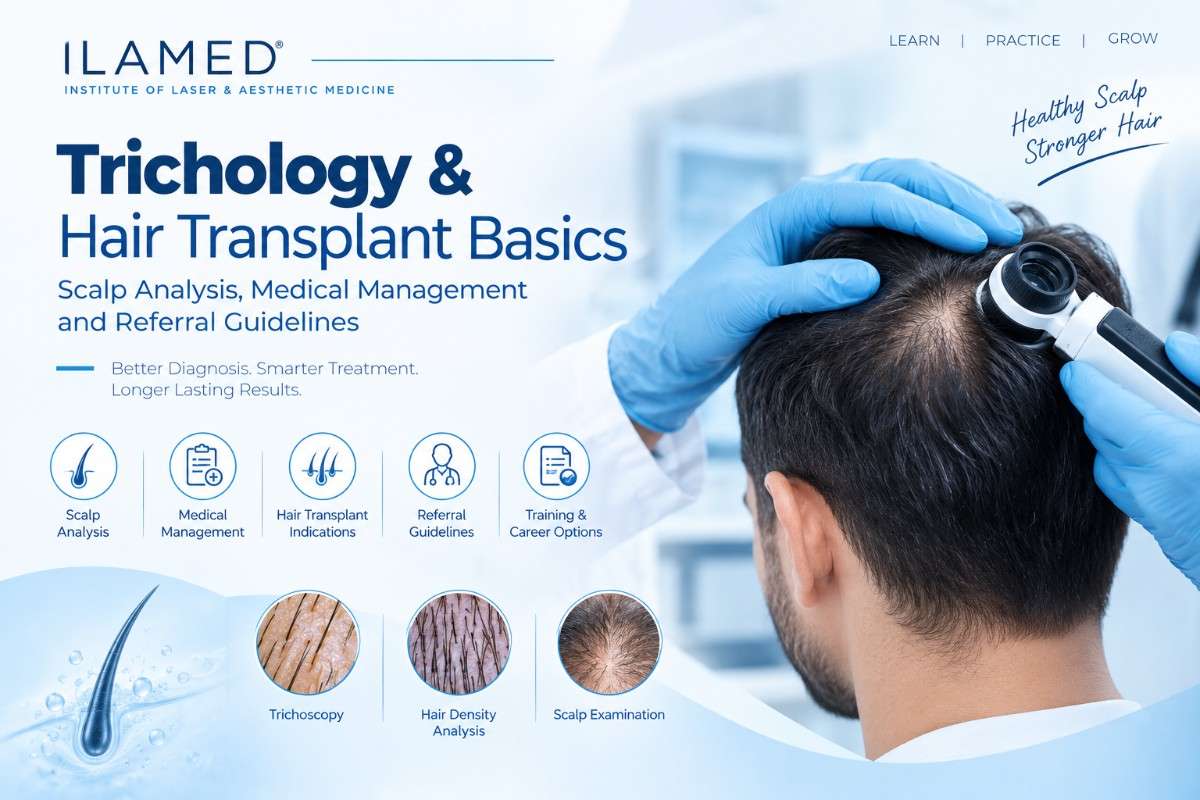
Hair loss is one of the most common reasons people walk into a dermatology or aesthetic clinic. It is also one of the most misdiagnosed. A patient who asks for a hair transplant courses may actually have telogen effluvium, an inflammatory scalp condition, or an unstable pattern of loss that will not suit surgery yet. Getting the diagnosis right comes first, and that is where trichology matters.
This guide explains the core of trichology, how a proper scalp analysis works, what medical management can achieve, when a hair transplant courses is the right answer, and how to refer patients safely. If you are a medical practitioner thinking about formal training, it also covers what to look for in a trichology course in India.
What Is Trichology?
Trichology is the scientific study of hair and scalp health, covering the structure, growth cycle, diseases and disorders of hair and the skin that supports it. A trichologist or hair-focused clinician evaluates why hair is thinning, shedding or breaking, and what can be done about it.
In modern practice, trichology sits between dermatology, endocrinology, nutrition and aesthetic medicine. The best clinicians do not jump straight to a procedure. They identify the cause, stabilise the condition, and only then decide whether a hair transplant courses belongs in the plan.
The Hair Growth Cycle in Brief
Every hair follicle cycles through three main phases:
- Anagen (growth phase): lasts 2 to 7 years and accounts for roughly 85–90% of scalp hairs.
- Catagen (transition phase): a short phase of a few weeks in which the follicle shrinks.
- Telogen (resting phase): lasts about 2 to 3 months, after which the hair sheds and a new anagen hair begins.
Most hair loss comes from a disturbance in this cycle. In androgenetic alopecia the anagen phase shortens and follicles miniaturise. In telogen effluvium, a trigger pushes many follicles into telogen at once. In scarring alopecias, the follicle is permanently destroyed.
Why Scalp Analysis Is the Foundation
A hair transplant courses moves healthy follicles from a donor area to a thinning area. If the underlying cause of loss is not diagnosed and controlled, the patient can keep losing native hair around the transplanted zone and end up with an unnatural result. Scalp analysis is the step that prevents this.
Step 1: Detailed History
A good consultation spends real time on history. Key questions include:
- Onset, duration and pattern of hair loss, and whether shedding is diffuse or patterned
- Family history of hair loss on both sides
- Recent illness, fever, surgery, weight loss, childbirth or major stress in the previous 3 to 6 months
- Diet, crash dieting, vegetarian or vegan eating patterns
- Medications and supplements, including steroids, anabolic substances and hormonal therapy
- Hair-care habits: tight hairstyles, heat styling, chemical treatments, frequent colouring
- Associated symptoms such as itching, burning, pain, scaling or pustules
Step 2: Clinical Examination
Examination covers the whole scalp and also the eyebrows, beard, body hair and nails. Look at density, the hairline, the crown, redness, scaling, loss of follicular openings and any scarring. The simple hair pull test helps assess active shedding: gently pulling a small group of hairs and counting how many come out. More than a few hairs per pull suggests active shedding.
Step 3: Trichoscopy
Trichoscopy is dermoscopy of the scalp and is now central to diagnosis. It allows magnified, non-invasive viewing of the follicular openings, hair shaft and perifollicular skin. It helps you see:
- Variation in hair shaft thickness (anisotrichosis), a hallmark of androgenetic alopecia
- Yellow dots, exclamation-mark hairs and black dots in alopecia areata
- Perifollicular scaling and redness in inflammatory conditions
- Loss of follicular openings in scarring alopecia
Trichoscopy often separates conditions that look identical to the naked eye, which makes it one of the highest-value skills for any clinician considering a hair transplant courses practice.
Step 4: Densitometry and Photography
Standardised photographs and hair density and calibre measurements give a baseline. They let you track response to treatment objectively and show patients real progress, which improves adherence. They also help plan the donor and recipient areas if surgery becomes necessary.
Step 5: Investigations
Tests are chosen based on history and examination, not ordered blindly. Commonly considered tests include:
- Complete blood count and ferritin
- Thyroid profile
- Vitamin D and vitamin B12
- Hormonal evaluation in women with signs of androgen excess, such as irregular cycles, acne or hirsutism
- Scalp scraping or culture when fungal infection is suspected
- Scalp biopsy when scarring alopecia is suspected or the diagnosis is unclear
Common Causes of Hair Loss
Androgenetic Alopecia (Pattern Hair Loss)
This is the most common cause of hair loss in both men and women. In men it follows the Norwood–Hamilton pattern, with a receding hairline and crown thinning. In women it usually shows as diffuse thinning over the central scalp, often described by the Ludwig scale, with the frontal hairline preserved. It is progressive, so treatment is ongoing.
Telogen Effluvium
This is diffuse shedding that appears a few months after a trigger such as high fever, surgery, childbirth, severe stress, crash dieting or a nutritional deficiency. It is usually reversible once the trigger is removed. Patients with this condition do not need a hair transplant courses. They need reassurance and correction of the cause.
Alopecia Areata
An autoimmune condition causing round patches of hair loss. It can be unpredictable, and surgery is generally not appropriate while the disease is active.
Scarring (Cicatricial) Alopecias
Conditions such as lichen planopilaris, frontal fibrosing alopecia and discoid lupus destroy follicles permanently. Early diagnosis matters because treatment aims to stop progression. These patients need specialist dermatology care and should not be rushed into a hair transplant courses.
Other Causes
Traction alopecia from tight styling, tinea capitis, seborrhoeic dermatitis, trichotillomania and hair loss from medications or thyroid disease also appear regularly in clinics.
Medical Management: What Can Be Done Before Surgery?
For many patients, medical therapy slows loss, thickens existing hair and may defer or even avoid surgery. It also prepares the scalp and protects native hair around a transplant.
Topical Minoxidil
A widely used treatment for pattern hair loss in men and women. It prolongs the growth phase and increases hair calibre. It needs consistent use, and patients should expect an initial shed and several months before visible improvement.
Finasteride and Dutasteride
These 5-alpha-reductase inhibitors reduce conversion of testosterone to DHT, the hormone that drives follicular miniaturisation in men. They are prescription medicines. Side effects, contraindications and use in women or those planning pregnancy must be reviewed by a qualified doctor, and patients should never self-medicate.
Oral Minoxidil
Low-dose oral minoxidil is increasingly used in clinical practice. Because it is a systemic medicine, patient selection and monitoring for side effects such as fluid retention, palpitations and excess facial hair are important.
Platelet-Rich Plasma (PRP) and Other Procedures
PRP uses a concentration of the patient’s own platelets injected into the scalp and is a popular adjunct. Evidence supports modest benefit, results vary, and several sessions are typically needed. Low-level laser therapy and microneedling are other adjuncts used in practice. These are best presented as supportive options, not guaranteed cures.
Nutrition and Lifestyle
Treating iron deficiency, thyroid dysfunction, vitamin D deficiency or B12 deficiency can improve shedding. Supplements should be based on test results, not on trends. Gentle hair care, stress management, sleep and a balanced protein intake all support recovery.
Hair Transplant courses Basics: When Is Surgery the Right Option?
A hair transplant is a surgical procedure in which follicular units are harvested from a permanent donor zone, usually the back and sides of the scalp, and implanted into areas of thinning or baldness. The donor hair tends to be resistant to DHT, so transplanted follicles generally keep growing in their new location.
Main Techniques
- FUE (Follicular Unit Extraction): individual follicular units are extracted with a small punch, leaving tiny dot-like marks. It is the most commonly offered approach today.
- FUT (Follicular Unit Transplantation or strip method): a strip of scalp is removed from the donor area and dissected into grafts. It leaves a linear scar but can provide many grafts in a single session.
- DHI and implanter-based techniques: use special implanter pens to place grafts directly after extraction. Claims of superiority should be treated carefully, as results depend heavily on the surgeon and team.
Who Is a Good Candidate?
A good candidate generally has:
- A stable, clearly diagnosed pattern of hair loss, usually androgenetic alopecia
- Adequate donor density and good donor hair quality
- Realistic expectations about coverage and the number of sessions required
- No active scalp disease or uncontrolled medical condition
- A plan for medical therapy to protect existing hair after surgery
Younger patients with an evolving pattern deserve caution. A very early surgery can leave an unnatural look years later as native hair continues to recede.
Who Should Not Be Rushed Into Surgery?
Patients with active alopecia areata, scarring alopecia, uncontrolled scalp inflammation, unrealistic expectations, very poor donor supply or body dysmorphic concerns need further assessment before any hair transplant is considered.
Timeline and Recovery
After a hair transplant, patients usually see small scabs for about a week. The transplanted hairs often shed within the first few weeks, which is normal. New growth typically starts around 3 to 4 months, and the final result is usually judged between 9 and 12 months, sometimes longer. Following post-operative instructions and continuing medical therapy matter as much as the surgery itself.
Possible Complications
Complications include infection, poor graft survival, folliculitis, swelling, numbness, visible scarring, unnatural hairline design and over-harvesting of the donor area. Most of these are linked to poor patient selection, poor technique or poor aftercare. That is why training and diagnosis matter so much.
Hair Transplants in India: What Patients and Practitioners Should Know
Hair transplants in India have grown rapidly, and the country is now a well-known destination for both domestic and international patients. Metro cities, in particular, have a large number of clinics offering a range of techniques at varied price points.
This growth brings opportunity and risk. Quality varies widely. Some centres have experienced, well-trained doctors and clear protocols, while others rely on under-qualified staff or aggressive marketing and unrealistic promises. For hair transplants in India to remain safe and credible, practitioners need proper medical training in diagnosis, patient selection, surgical planning and complication management.
When evaluating a clinic or building your own practice, consider:
- Who performs the key surgical steps? Hairline design and critical decisions should be made by a qualified doctor.
- Is diagnosis done first? A reputable clinic examines the scalp, uses trichoscopy and explains why surgery is or is not suitable.
- Are expectations realistic? No ethical clinician promises 100% growth or a guaranteed result.
- Is long-term care planned? Medical therapy and follow-up should be part of the plan.
- Is the pricing transparent? Cost depends on the number of grafts, technique and surgeon experience, so it should be explained clearly.
Referral Guidelines: Knowing When to Refer
Not every patient with hair loss should be treated by the same clinician. Good practice includes knowing the limits of your scope and referring in a timely manner. These guidelines are a general framework, and every decision should follow local regulations and clinical judgment.
Refer to a Dermatologist When
- You suspect scarring alopecia, such as lichen planopilaris, frontal fibrosing alopecia or discoid lupus
- There is significant scalp inflammation, pain, pustules or rapidly spreading patches
- A scalp biopsy is needed or the diagnosis remains unclear
- Alopecia areata is extensive, rapidly progressive or affects the eyebrows, beard or nails
- Fungal infection of the scalp is confirmed or strongly suspected
Refer to an Endocrinologist or Physician When
- Thyroid disease, anaemia or another systemic disorder is found
- Women show signs of androgen excess such as irregular periods, hirsutism or persistent acne
- Blood results are significantly abnormal
- The patient has complex medical conditions or is taking multiple medications
Refer to a Hair Transplant Surgeon When
- The diagnosis is stable, usually androgenetic alopecia, and medical therapy alone cannot achieve the patient’s goals
- Donor supply is adequate and the patient is a suitable candidate
- The patient has had a previous poor-quality procedure and needs repair or corrective planning
- The area of baldness is stable and the patient has realistic expectations
Refer for Psychological Support When
- The patient shows distress out of proportion to the clinical findings
- You suspect trichotillomania or body dysmorphic disorder
- Expectations remain unrealistic despite thorough counselling
Red Flags Needing Prompt Attention
- Sudden severe hair loss with systemic symptoms
- Painful, burning or rapidly progressive scalp lesions
- Hair loss after starting a new medication
- Signs of infection after a procedure
Why Formal Training Matters: Choosing a Trichology Course in India
Many practitioners start with an interest in hair transplants and soon realise that the real skill lies in diagnosis and decision-making. A well-designed trichology course in India gives medical professionals the structured knowledge to do that safely and confidently.
What a Good Trichology Course in India Should Cover
- Hair and scalp anatomy and physiology
- The hair growth cycle and classification of hair disorders
- Hands-on trichoscopy and interpretation
- Clinical history taking and scalp analysis
- Medical management, including topical and systemic therapies
- Role of PRP and other adjunct treatments
- Introduction to hair transplant techniques, candidate selection and planning
- Complication recognition and management
- Counselling, consent and ethical practice
- Referral pathways and documentation
Features to Look For
- Faculty with clinical experience: teachers who actively treat patients bring practical insight.
- Hands-on training: live demonstrations and supervised practice build real skills.
- Case-based learning: real clinical scenarios improve decision-making.
- Eligibility clarity: the course should state clearly who can enrol, such as MBBS, BDS and other qualified practitioners, and what scope of practice the training supports.
- Certification and ongoing support: alumni networks and continuing education keep your skills current.
Choosing a reputable trichology course in India is a career investment. It helps practitioners add hair and scalp care to their clinics, build patient trust and understand when a hair transplant is or is not appropriate.
What is the difference between a trichologist and a hair transplant surgeon?
A trichologist focuses on diagnosing and managing hair and scalp conditions, usually through non-surgical care. A hair transplant surgeon performs the surgical procedure. Many good surgeons have strong trichology knowledge, because accurate diagnosis comes before surgery.
Is a hair transplant permanent?
The transplanted follicles come from DHT-resistant donor areas and usually keep growing for life. However, native hair around the transplanted area can continue to thin, so many patients need medical therapy or a future session to maintain a natural look.
How much does a hair transplant cost in India?
Cost depends on the technique, number of grafts, surgeon experience, clinic location and technology. Rather than choosing the lowest price, patients should ask for a clear breakdown and a realistic graft estimate after examination.
Are hair transplants in India safe?
They can be safe when performed by qualified, experienced doctors in a properly equipped setting with good patient selection and aftercare. Quality varies between clinics, so research the surgeon’s credentials, review real before-and-after results and ask who will perform each step.
Who is not suitable for a hair transplant?
People with active scalp disease, unstable or diffuse hair loss, scarring alopecia, very poor donor density or unrealistic expectations may not be suitable. A proper scalp analysis helps determine this.
Can medicines alone stop hair fall?
For many people with pattern hair loss, medical treatment can slow progression and improve density. Results depend on the cause, the stage of loss and consistent use. Some patients combine medicines with a hair transplant for better long-term outcomes.
Final Thoughts
A successful hair transplant begins long before the procedure. It starts with listening, careful scalp analysis, an accurate diagnosis and honest counselling. Medical management protects the hair a patient already has, and timely referrals keep patients safe. As demand for hair transplants in India continues to rise, clinicians with solid trichology foundations will stand out for quality and ethics.
If you want to build these skills, look for a trichology course in India that combines science, hands-on practice and responsible clinical guidance. That training helps you decide who truly needs a hair transplant, and who is better served by another path.