Introduction
The beauty and aesthetic business in India is in a remarkable change. As per the report by the 2024, India has emerged as one of the top 10 countries worldwide for non-surgical cosmetic procedures. Indian practitioners reported more than 1.2 million botulinum toxin treatments and almost 800,000 hyaluronic acid filler treatments in the single year for which data is available. This is resulting in a tremendous demand for well-trained and qualified staff.
So, if you are a medical practitioner and looking for the top clinical cosmetology course in India, you are at the right place. This detailed resource offers objective and scientifically-based data on clinical cosmetology course requirements, coursework, skills, job prospects, and legal requirements. We will also discuss what some of the top institutes in the field such as ILAMED (Institute of Laser & Aesthetic Medicine) are sharing with us, along with experts like Dr. Ajay Rana, who has been in the business for more than 25 years.
If you are a doctor (MBBS), a dentist (BDS), a practitioner (BAMS/BHMS), or a nurse, this article is for you and will help you make an educated decision for your aesthetic medicine education.
What is a clinical Cosmetology Course?
A clinical cosmetology course is a special training course for medical and allied healthcare professionals. Clinical cosmetology is more of a medical approach to beauty cosmetics which uses medically approved, non-surgical cosmetic procedures conducted in clinical environments.
Common Procedures Covered in Clinical Cosmetology:
| Procedure | Description |
| Botulinum Toxin (Botox) Injections | Eliminates wrinkles and fine lines from face. |
| Dermal Fillers | Restores volume with Hyaluronic acid or Calcium hydroxylapatite |
| Laser Hair Reduction | Permanent treatment for unwanted hair with the use of Class 4 laser technology |
| Skin Rejuvenation | PRP therapy, MNRF, HIFI for glowing skin |
| Chemical Peels | Exfoliates and removes acne scars & pigmentation |
| Thread Lifts | Non-surgical face lift technique using threads |
| Scar & Tattoo Removal | Laser removal of unwanted marks |
These treatments involve specialized medical equipment, prescription-only drugs and careful assessment of the patient. So, a formal training is not a choice, it’s a necessity.
Expert Opinion: Dr. Ajay Rana, Founder of ILAMED says, “Clinical Cosmetology is not cosmetology, it is medical science applied to cosmetics, so if anyone is not trained, he can cause serious complications like bruising, infection, vascular occlusion and more.”
What makes Clinical Cosmetology so popular in India?
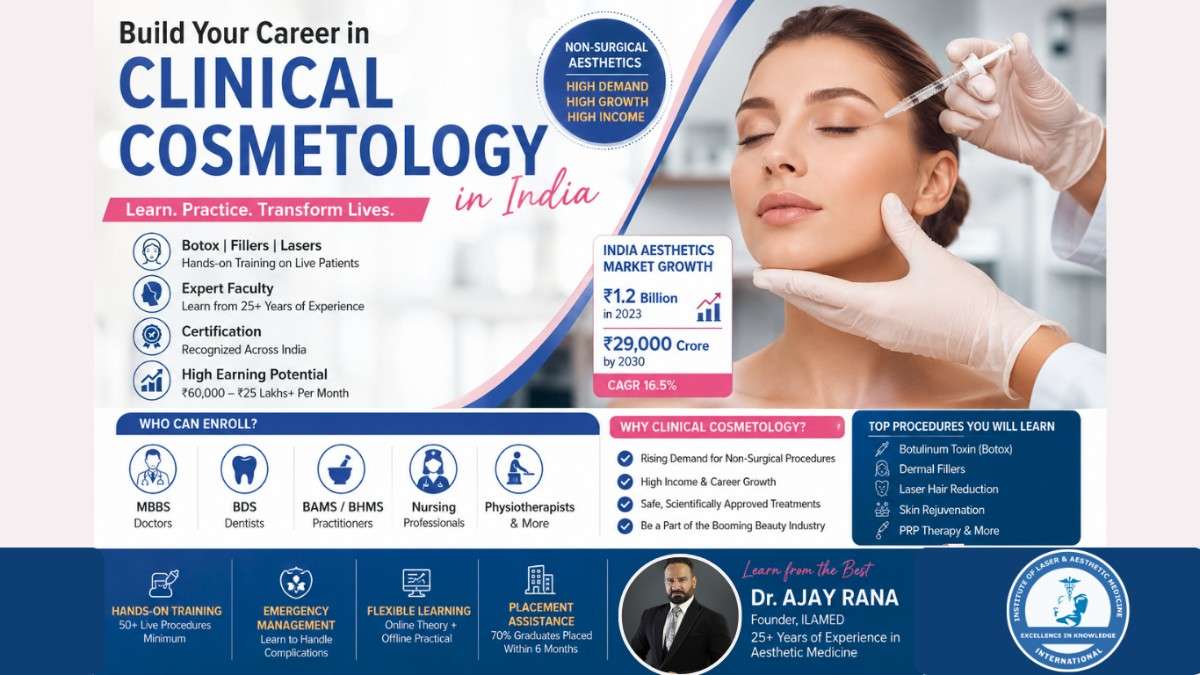
In 2023, the Indian medical aesthetics market had a total value of about ₹1.2 billion, and a compound annual growth rate (CAGR) of 16.5% is expected to drive the market to $3.5 billion (approximately ₹29,000 crore) by 2030 (Source: Market Research Future, 2024).
The current and future opportunities for growth are identified as:
- Increasing disposable incomes – More and more Indians have money for aesthetic treatments.
- Increased awareness and desire to enhance appearance through social media.
- Patients value minimally invasive treatments, particularly those that have a brief recovery period.
- India is a prime location for medical tourists seeking quality and budget-friendly aesthetic treatments from Bangladesh, Sri Lanka, Africa, and the Middle East.
- Male esthetics: An estimated growth of 40% YOY is expected for male aesthetic procedures.
Thus, there is an ever-growing need for the best clinical cosmetology course in India.
Who can take a clinical Cosmetology Course? (Complete Eligibility Table)
This is a question that people ask a lot. The following eligibility matrix is applicable in the context of current medical laws and policies in India.
| Qualification | Eligible for Clinical Cosmetology? | Allowed to inject Botox/Fillers? | Allowed to perform laser procedures? |
| MBBS (Doctor) | ✅ Yes | ✅ Yes (after certified training) | ✅ Yes |
| BDS (Dentist) | ✅ Yes (facial aesthetics only) | ✅ Yes (below eyes & lower face) | ⚠️ Limited (non-invasive only) |
| BAMS / BHMS (Ayurveda/Homeopathy) | ✅ Yes | ⚠️ Depends on state council | ✅ Yes (non-injectable devices) |
| GNM / B.Sc Nursing | ✅ Yes | ❌ Cannot inject; can assist | ✅ Yes (under supervision) |
| Physiotherapist | ✅ Yes (laser & machines only) | ❌ No | ✅ Yes (non-injectable devices) |
| Non-medical (B.Sc, diploma, beautician) | ❌ No | ❌ No | ❌ No |
Addressing Your Question: Can a BDS Doctor Do a Clinical Cosmetology Course?
Yes. BDS (dental) graduates can opt for clinical cosmetology but only for the area below the eye line and the bottom portion of the face. A large number of dentists are able to effectively perform perioral aesthetics such as lip fillers and smile line corrections. ILAMED provides specialized modules for BDS professionals so that they are able to work within the boundaries of the law.
Is Clinical Cosmetology legal for non-doctors in India?
No. Non-medical professionals (beauticians, B.Sc non-medical, diploma holders) are not legally allowed to do clinical cosmetology procedures that use injections or prescription devices. Indictments may result when a drug is used in an off-label manner, or if the drug is prescribed to a patient who suffers injury (under IPC Section 337 – causing hurt by rash act), license may be revoked and civil liability for patient harm may be sought.
Dr. Ajay Rana states: “Patient safety is a paramount thing and only an expert medical practitioner who has been trained in the field of clinical cosmetology should perform such procedures.”
What is Best – Cosmetology or Aesthetic Medicine?
Aesthetic medicine provides more advanced surgical training for MBBS physicians, training them in managing complicated outcomes. A clinical cosmetology course may be more suitable and available for the following professionals: BDS, BAMS, BHMS and nursing. A good clinical cosmetology course in India will teach you all the necessary procedures without going beyond your scope of practice. Aesthetic medicine is better suited for individuals who have a particular focus on only injectable and advanced laser procedures.
Is it possible to make money after completing a Cosmetology Course?
Yes. There is a lot of money in it and it’s supported by data. A survey conducted by Indian Institute of Laser & Aesthetic Medicine and placement data from institutes such as ILAMED indicate that:
| Level of Experience | Monthly Salary (Clinic/Chain) | Independent Practice Income |
| Fresher (0–1 year) | ₹60,000 – ₹90,000 | ₹1.5 – ₹3 lakhs |
| Mid-level (2–4 years) | ₹1.2 – ₹2 lakhs | ₹4 – ₹8 lakhs |
| Senior (5+ years) | ₹2.5 – ₹4 lakhs | ₹10 – ₹25 lakhs |
Actionable Tip: Get a head start with a senior aesthetic physician to maximize earnings for 6-12 months. Then consider opening your own clinic using rented equipment instead of purchasing expensive lasers. Keep emergency drugs (e.g., hyaluronidase for complications related to fillers) stored on-site.
What are the risks of clinical cosmetology treatments?
Although clinical cosmetology treatments are relatively non-invasive, there are some risks involved. A certified course will instruct you on how to avoid and control these complications.
| Procedure | Potential Risk | Emergency Management |
| Botox | Ptosis (drooping eyelid), asymmetry | Supportive care; resolves in 2-4 weeks |
| Hyaluronic acid Fillers | Vascular occlusion (skin necrosis) | Immediate hyaluronidase injection |
| Laser | Burns, hyperpigmentation | Cooling, topical antibiotics |
| Chemical peels | Scarring, infection | Proper depth assessment, post-care |
| Thread Lifts | Infection, thread extrusion | Antibiotics, thread removal |
Dr. Ajay Rana says: “It is a fact that every aesthetic practitioner should have an emergency protocol within reach at any point of time as soon as the case of fillers is discussed. Hyaluronidase, Adrenaline and emergency contact numbers must be within arm’s reach during any filler procedure.”
Do Cosmetology courses offer certification?
Yes. Good clinical cosmetology training courses offer certification at the end of the theory and clinical assessments.
Factors to consider when choosing a certificate:
- Institute name and accreditation
- Duration of training
- Procedures covered
- Number of hours of hands-on experience
- Formal signatures of faculty members (preferably from well-known faculty such as Dr. Ajay Rana)
- Certificate recognized by hospitals and clinics
Note: There is no medical doctorate degree in clinical cosmetology or aesthetic medicine in India yet. However, private institutes such as ILAMED offer diplomas and fellowships which are easily accepted by employers throughout India.
Are Cosmetology Courses that cover Laser Treatment Training available?
Yes. Laser training is an essential part of a solid clinical cosmetology course.
Topics usually covered in laser training:
- Understanding of how laser light interacts with tissues and laser physics
- Safety procedures (eye protection, patient selection)
- Laser hair reduction (different skin types)
- Laser tattoo removal with Q-switched and picosecond lasers
- Fractional laser for scar removal and skin tone improvement
- Laser for thread veins and redness in blood vessels
Hands-on requirement: Must practice on live patients under supervision to understand fluence, pulse duration and cooling. The best clinical cosmetology course in India provides at least 20-30 hours of laser hands-on training.
Can I learn Cosmetology Online with Practical Training?
A very important question. The answer is, in short, “partly, but not fully.”
What Can Be Learned Online:
- Anatomy and physiology
- Pharmacology of injectables
- Laser physics
- Patient consultation protocols
- Complication recognition
What Can’t Be Learned Online:
- Needle handling and injection technique
- Laser handpiece positioning
- Real-time complication management
- Patient interaction skills
Recommended Approach: Blended Learning Model
Dr. Ajay Rana, ILAMED, says: “Online theory helps busy doctors but hands-on practical training on live patients is a must. No single online course can make a doctor a competent aesthetic practitioner.”
Select a program that provides:
- Theory modules (flexible timing) online
- Face-to-face hands-on training sessions (3-5 days intensive)
- Mentorship or preceptorship (optional but recommended)
Curriculum of the Best Clinical Cosmetology Course in India
Any good clinical cosmetology course would include both theory and hands-on. The curriculum usually consists of the following:
Module 1: Foundations of Aesthetic Medicine
- The structures of the face, neck and body
- Skin biology and aging process
- Patient consultation and psychological evaluation
- Informed consent and documentation
Module 2: Botulinum Toxin (Botox) Training
- Pharmacology and storage
- Injection techniques for forehead, crow’s feet and glabellar lines
- Complication management (ptosis, bruising, asymmetry)
Module 3: Dermal Fillers
- Different types of fillers (hyaluronic acid, calcium hydroxylapatite)
- Lip, cheek and nasolabial fold injection techniques
- Treatment of vascular occlusion (hyaluronidase emergency procedure)
Module 4: Laser Aesthetics
- Physics of light-based devices
- Laser hair reduction
- Laser tattoo removal and laser scar removal
- Skin rejuvenation using fractional lasers
Module 5: Advanced Aesthetic Procedures
- PRP for hair loss and skin regeneration
- Micro-needling Radiofrequency (MNRF)
- Different chemical peels (superficial, medium and deep)
- Thread lifting technique (PDO threads)
Module 6: Safety, Ethics and Legal Compliance
- Emergency management
- Side effects and complication management
- Medical indemnity insurance
- Compliance with the Clinical Establishments Act
Module 7: Hands-on Clinical Training
- No less than 50-100 procedures on actual patient(s)
- Practice on anatomical models
- Mentorship by experienced aesthetic physicians
Dr. Ajay Rana says: “Theoretical knowledge is no use in clinical cosmetology; it should be taught through practicals with a minimum of 60% of training being clinical on live patients.”
Hands-on skills that you will acquire
After finishing the best clinical cosmetology course in India, you’ll gain the following hands-on skills:
| Skill | Proficiency Level |
| Botox injection techniques | Independent practice |
| Dermal filler placement | Independent practice |
| Laser device operation | Independent practice |
| PRP preparation and injection | Independent practice |
| Chemical peel application | Independent practice |
| Complication management | Emergency response capability |
| Patient consultation | Professional level |
Step-by-Step Action Plan to Become a Clinical Cosmetology Practitioner
Use this checklist to get started in your career:
| Step | Action | Duration |
| 1 | Complete all documentation (MBBS/BDS/BAMS/BHMS/Nursing) | 5 days |
| 2 | Contact 3-4 institutes for applications (ILAMED, ETC.) | 1 week |
| 3 | Enroll in a registered Clinical Cosmetology course | – |
| 4 | Complete theory and practical training (minimum 50 procedures) | 3-12 months |
| 5 | Obtain certification | – |
| 6 | Get medical malpractice insurance | – |
| 7 | Start practicing under mentorship or in a reputed clinic | – |
| 8 | Start your own aesthetic clinic (optional) | After 6-12 months |
Institutes offering Clinical Cosmetology Courses in India
There are a number of institutes, but here are some recognized ones for your research. ILAMED is one of the oldest.
| Institute Name | Common Courses | Locations |
| ILAMED (Institute of Laser & Aesthetic Medicine) | Clinical Aesthetics, Diploma in Aesthetic Medicine, Certified Botox & Filler Training | Delhi, Mumbai, Bangalore, Hyderabad, Pune, Kolkata |
| American Academy of Aesthetic Medicine (AAAM) – India Chapter | Certificate courses in Botox, Fillers, Lasers | Multiple cities |
| IADVL (Indian Association of Dermatologists) | Workshops and Fellowships for dermatologists | Across India |
| University affiliated programmes | PG Diploma in Aesthetic Medicine (limited seats) | Karnataka and other states |
Note: Dr. Ajay Rana, a 25-year expert in aesthetic medicine, is the founder of ILAMED. According to his institute, they have trained more than 8,000 doctors from 15 countries. Aspirants are requested to cross-check these and compare institutes before enrolling.
Frequently Asked Questions (FAQ) – Additional Queries
Q1. What is the length of a typical clinical cosmetology class?
Course durations vary. Botox/fillers only certificate courses are 3-5 days long. Diploma programs range from 6 months to 1 year. Fellowships may last up to 12-18 months with mentorship.
Q2. Is there any age limit to enroll in a clinical cosmetology course?
No. There is no maximum age. As long as you have a valid medical or allied healthcare degree and are in good standing, you can enroll. Many doctors in their 40s and 50s seek this course as a career addition.
Q3. Will I be able to practice clinical cosmetology in several states after taking a single course?
Yes, but MBBS doctors must register with the medical council of the corresponding state. If you are working as a BDS, BAMS or nurse, your practice scope may vary by state. Be sure to check local regulations.
Q4. What is the refund policy if I am not satisfied with a course?
This varies by institute. Quality schools like ILAMED have written refund policies. Read the rules thoroughly. Request a demo or speak with alumni prior to paying fees.
Q5. Do clinical cosmetology course fees come with an EMI option?
Yes. Many institutes, including ILAMED, provide EMI facilities without cost through banks. Fees vary between ₹50,000 for short certificate courses to ₹3-5 lakhs for complete diplomas.
Q6. Are foreign medical graduates (FMGs) allowed to join clinical cosmetology courses in India?
Yes. FMGs who are medically registered in their home country can enroll. However, they must check whether their foreign degree is recognized by Indian authorities for independent practice. Dr. Ajay Rana advises FMGs to first take FMGE (Foreign Medical Graduate Examination) to practice in India.
Q7. What is the placement rate after completing a course at ILAMED?
The placement rate for ILAMED graduates is more than 70% within the first six months of graduation. Placement assistance includes resume building, interview preparation, and networking with partner clinics such as VLCC, Kaya, and independent aesthetic clinics.
Q8. Does a clinical cosmetology certification need to be renewed?
Certification does not expire, but it is highly recommended to earn continuing medical education (CME) credits every year. Aesthetic medicine is continually evolving, changing every 2-3 years. Dr. Ajay Rana suggests attending advanced workshops every 12-18 months.
Conclusion
A clinical cosmetology course is a valid and beneficial option for medical and allied healthcare professionals in India. The number of non-surgical aesthetic procedures being performed is growing exponentially, with superb career prospects. But, it all comes down to how well you train yourself.
The best clinical cosmetology course in India should focus on patient safety, have sufficient practical experience with live patients, be taught by experienced lecturers (like Dr. Ajay Rana at ILAMED), and provide a certificate recognized by employers.
Check eligibility, research several institutes, compare hands-on hours, and always ensure the program includes emergency management training before enrolling. With the right education, you can have a fulfilling and high-paying career in aesthetic medicine and help patients look and feel their best.
Note: This article is meant for informational purposes only. Any procedure undertaken by a medical practitioner must be done in consultation with the relevant State Medical Council to ensure eligibility and scope of practice.