Introduction
Botox course in India is a prescription-only medicine under the Drugs and Cosmetics Act, thus is legally qualified and licensed medical practitioners who have been trained in Botox injections. This is a general term, which applies to doctors of MBBS, dentists of BDS/MDS, and AYUSH/nursing professionals working under the supervision of a registered medical practitioner. It cannot be legally carried out by beauticians, cosmetologists or anyone without a recognized medical or dental license, which was reiterated by the Government of India (CDSCO) in some recent circulars stating that injectable procedures are strictly medical, not cosmetology.
If you’re wondering whether you specifically are eligible, here’s the detailed breakdown.
What makes Botox eligibility so confusing for many people in India?
When you type in “who can do Botox course in india ” most of the information returned is geared toward the USA — state by state nurse practitioner laws, medical spa ownership regulations, physician-delegation models that aren’t applicable to the Indian healthcare system. This mismatch is the cause of most confusion.
Several states in the USA permit nurse practitioners to prescribe and inject. Prescribing in India is much more closely linked to a registered medical or dental degree and there is no parallel “independent nurse practitioner” route for aesthetic injectables in India. In addition to this, the vast number of “5-day certificate” courses aggressively promoted on social media often fails to make it clear that a certificate in and of itself does not replace the underlying, legal requirement of a medical license, and it’s no wonder practitioners and patients alike get confused about where the real line is.
The most obvious difference is that Botox (botulinum toxin) is considered a prescription drug and not a cosmetic product, under the Drugs and Cosmetics Act. That is the one classification that governs all others: who may prescribe it, who may administer it, and who may not even touch it. The Central Drugs Standard Control Organisation (CDSCO) took a step further in 2026 and clarified specific points on injectable cosmetic products that “cosmetics are meant for external use only” and that “injectable cosmetic products do not belong to the scope of qualified medical practice”.
Under that regulatory framework, here are the positions of healthcare professionals.
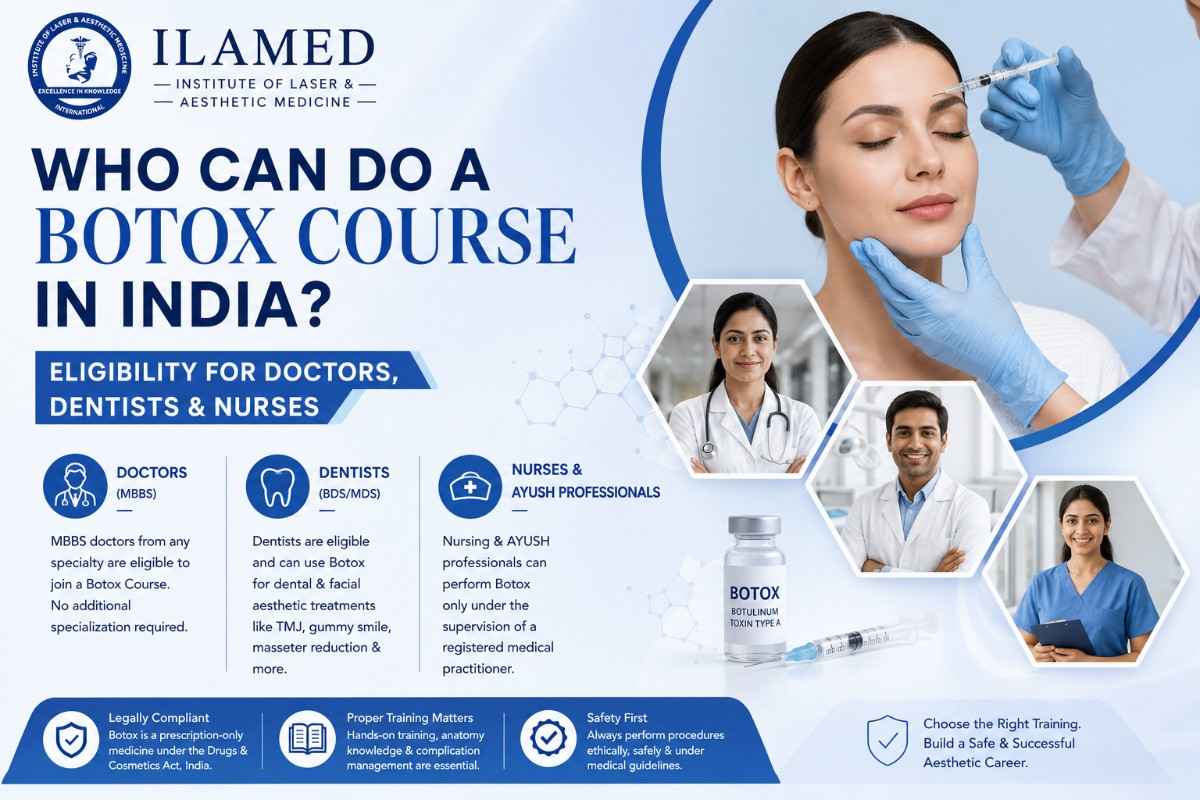
Yes, MBBS Doctors are eligible to join a Botox Course.
Yes – any doctor with an MBBS degree is automatically qualified without any specialization. You don’t need to be a dermatologist or plastic surgeon to train in Botox. Doctors from a variety of clinical specialties are often attracted to aesthetic medicine via structured Botox and filler courses, with general practitioners, gynaecologists, ENTs and other doctors all coming into the field regularly.
However, it is strongly recommended that physicians who are not dermatologists and cosmetologists take a basic aesthetic medicine course (facial anatomy, danger zones and complication management) prior to more advanced courses in order to get a better understanding of the field.
In reality, some of the best estheticians in India didn’t even enter into dermatology. Patients already trust their gynaecologists for their sensitive and personal consultations so that’s why they enter into aesthetic medicine. ENT surgeons come with some background of knowledge in head and neck anatomy. After years of general practice, general physicians develop whole new careers in cosmetic medicine. The underlying medical registration is what matters legally; the clinical quality and depth of the specific training on Botox is what matters clinically.
A good MBBS Course usually covers:
- The facial muscles and “danger zones” unique to Botox
- Multiple dosing schedules for the various facial areas (glabella, forehead, crow’s feet, masseter, etc.).
- Assessment of the patient, contraindications, and realistic setting of goals.
- Complication recognition, management, ptosis and asymmetry and rare adverse events
- Real-life, supervised injection experience
Anatomy knowledge is already established and can be easily transferred to advanced or combination treatments (Botox, fillers, threads, and skin tightening treatments), thus allowing a faster progression into these procedures for doctors with a dermatology, plastic surgery or cosmetology background.
Yes, a Dentist (BDS/MDS) can take a Botox course.
Yes, and this is one of the fastest growing areas in aesthetic training. The dentists have an inbuilt benefit: they have in-depth knowledge about the anatomy of a face and mouth that is directly relevant to Botox treatments such as:
- Managing TMJ disorders and bruxism.
- Gummy smile correction
- Masseter reduction
- Lower face and jawline beautification
Botox training is generally integrated into the practice of cosmetic dentistry or facial aesthetics, and as such is not typically a career change but rather an integration of services offered.
This is undoubtedly the fastest growing eligible category in the Indian aesthetic medicine landscape at the moment. Patients already have an understanding of injections and being worked on around the face in dental clinics, which is a psychological advantage that general aesthetic clinics may not possess. Many dentists have discovered that it’s a great way to add more additional revenue to their practice per patient without having to go out and recruit many new patients.
For Dentists the most relevant course structure is typically:
- Upper-face Botox injections that could be seen within a dental scope (forehead lines and glabella)
- Dental anatomy knowledge is directly beneficial to lower face and jaw applications, such as masseter hypertrophy and bruxism or TMJ related pain.
- Smile aesthetics – Botox for gummy smile correction –
- Botox course in india can be also used in conjunction with other dental cosmetic procedures to achieve an overall aesthetic facial result.
One of the reasons some training providers provide a dentist-targeted track is that the clinical starting point for them, i.e. a thorough understanding of the oral and maxillofacial anatomy, but less exposure to upper-face injectable protocols, differs from a general MBBS doctor.
4. What is the qualification required for doing Nurses Course in India?
The confusion seems to lie here, partly because of the influence of U.S. based content (which nurse practitioners can prescribe and inject without) and partly because of the regulatory setting in India.
The Botox training in India can be done by the nurses and they can help with the Botox injection or inject the Botox only under direct supervision and prescription of the registered medical practitioner (a registered doctor). Unlike some nurse-practitioner models in other countries, nurses will not be allowed to prescribe Botox or administer the drug on their own authority.
The realistic route for qualified nurses interested in a career in aesthetic medicine is:
- Training in a certified course to develop technical skills
- Working in a clinic under a supervising doctor’s license.
- Looking for opportunities to work in medical aesthetics teams, med spas or dermatology/cosmetology clinics
This does not detract from the worth of a Botox course in india to a nurse, just its definition of “eligibility”. As the aesthetic clinics scale up patient numbers, a trained nurse becomes a much more useful addition to your staff as the perfect support to doctors, who can competently attend to procedures, oversee pre- and post-care, run consultations and even take on administrative tasks under a doctor’s direction.
Many nurses become this way: they work as trained assistant-injectors under a supervising physician, and eventually become the backbone of a very active aesthetic practice, albeit never the final “calling” of the practice. If you’re a nurse thinking you might pursue this, search for courses that are clear on scope of practice limits, not that they leave it “implied” that you are doing independent practice — this will help keep you safe for the long haul with your license.
4. Other Health Care Professionals?
The following professionals can also be considered:
- Doctors from AYUSH (BAMS, BHMS and BUMS) – Eligibility may vary among different states and their scope of practice; please check with the respective council before practicing alone
- Physiotherapists and allied health professionals (usually can receive foundational training, onsite supervision by a physician)
Who CAN’T?
“To cut a long story short, the following cannot legally inject Botox course in India, no matter what short-term certificate they might have:
- Beauticians and cosmetologists
- Salon and spa professionals who are not medical licensed.
- Skin care therapists (who are not MBBS/BDS/nursing qualified)
The CDSCO has made it very clear that cosmetic products are only intended for external use — injection procedures are medical, not cosmetic and both the practitioner and the person who performs the injection may find themselves in trouble with the law.
How a Genuine Institute will verify your eligibility.
A major red flag of a serious, reputable Botox training course as opposed to one that’s just looking to make a quick buck is what they request before you sign up. It is common for legitimate institutes to ask for:
- Your medical registration (MBBS/BDS/MD/MDS certificate and state council registration number) will be sent to the applicant.
- Documentation of nursing registration and (if applicable) a letter of arrangement for supervised practice.
- The simplest way to show that you are not just a non-medical enrollee looking to skirt the rules.
If a course is for everyone, does not ask you just one confirming question, and claims to be able to certify you to “inject” within a few days, no matter what your background is, be wary of the “shortcut” and move on. Not only is it a legal risk to you, but poorly vetted training environments tend to skimp on live-model practice, complication management training, and mentorship — the three things that make a confident, safe injector a risky one.
At a glance, Botox Course Eligibility includes the following details:
| Professional | Eligible to Train? | To be able to practice independently? |
| MBBS Doctor | Yes | Yes |
| BDS/MDS Dentist | Yes | Yes (for facial/oral procedures) |
| Nurse (GNM/BSc) | Yes | Only under doctor’s supervision |
| AYUSH (BAMS/BHMS/BUMS) | Varies by state | Check with respective council |
| Beautician/Cosmetologist | No | No |
| Salon/Spa Professional | No | No |
In addition to the above, doctors who are MBBS, ROHINI, or AYUSH must also meet the following requirements to achieve success in the program.
Along with the above, the following conditions are applicable for the success in this program for those who are MBBS, ROHINI or AYUSH doctors.
Q: No, anyone can learn Botox, dermatologists are not required to learn it.
No, Botox training and practice is open to any MBBS doctor irrespective of his specialization.
Q2. What is the eligibility for Botox course in India?
Botox course in india eligibility mein required hai:
Valid medical/dental degree (MBBS/BDS/MDS)
Registered medical license
Nurses ke liye: supervision under doctor
Q3. Can MBBS doctors do Botox course without specialization?
Yes, MBBS doctors can take Botox training without specialization in dermatology or plastic surgery.
Q4. Can dentists do Botox course in India?
Yes, dentists (BDS/MDS) are eligible and can perform Botox procedures, especially for facial and oral treatments.
Q6. Is Botox a good career option in India?
Yes, Botox is a rapidly growing field in aesthetic medicine and offers strong income potential for doctors and dentists.
Q7. Can I start practicing Botox after certification?
No, certification alone is not enough. You must also have a valid medical license to legally practice Botox.
Q8. Can non-medical professionals do Botox course in India?
No, beauticians, cosmetologists, and salon professionals are not legally allowed to perform Botox procedures.
Designed for those who are ready to embark on their Botox training journey.
From an MBBS doctor seeking to advance in facial aesthetics to a dentist looking to add specialties, or a nurse developing advanced skills under clinical guidance, ILAMED’s Botox and Dermal Filler courses are based on true pathways of eligibility — practical, hands-on training, live model practice, and mentorship from leading physicians in aesthetics.